The Road That Ended at Home
Chapter 10 · Green Ink, Black Ink
Page 96 of 276
Chapters
The original level book, borrowed from the office, smelled of dust, mouse-chewed leather, and the bitter oil Vezzi used on his instruments. Flavia laid it open beside her corrected section, holding down its curling leaves with the brass benchmark. The bolt recorded in the book had been set above the reclaimed peat, in the foundation of a mill that no longer stood. Its height agreed with her new reading to less than the width of a pencil line. She had checked it twice, and once more after the traverse with Nello. Vezzi had approved the readings for plotting, not the route for building.
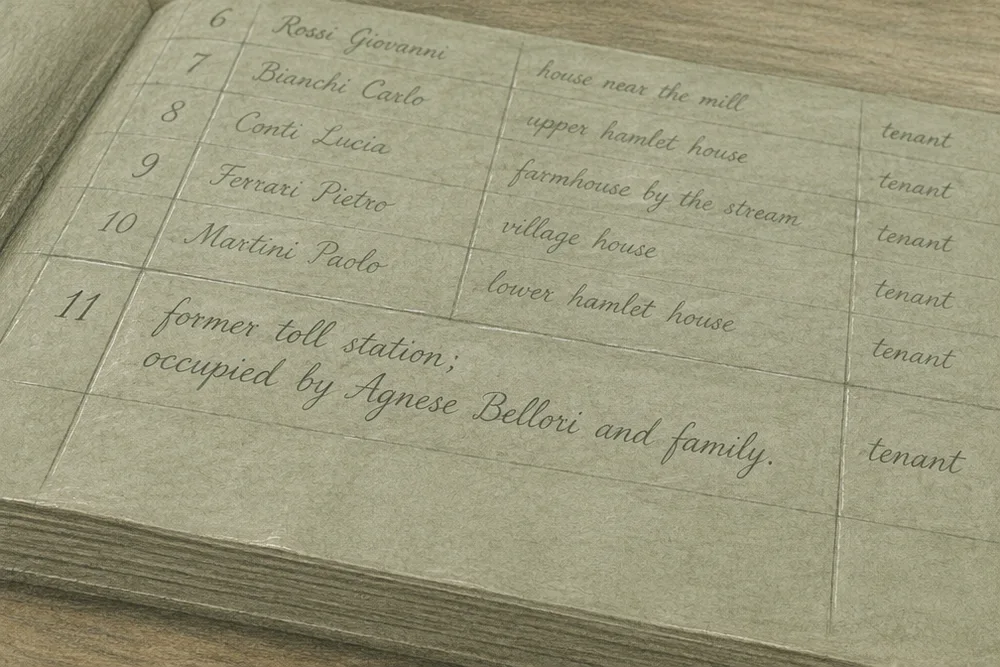
On her drawing, green ink marked the contour that could carry water around the Bellori kitchen. Black ink gave the old level, the new readings, and every occupied door. She had ruled the register in narrow columns: household, number of residents, use of ground, permission or lease if known. Beside the Bellori name she had written “former toll station; occupied by Agnese Bellori and family.” She had not put “owner.” There was no evidence for it. Nor had she written “vacant,” though the first estimate did.
Agnese sat at the table’s far end, still in her dark bib apron, silver braid wound tight against her head. Her erect posture made the hard chair seem a stool beneath her. She watched Flavia blot the final line. The smell of soap from Agnese’s sleeves mingled with the ink. Outside, the yard’s shallow ditch lay dry and furred with old reeds. Beyond it, the road to the town offices climbed toward firmer ground.
“You have put us in the register,” Agnese said.
“All the doors.”
“That was not what I asked.”
Flavia met her mother’s hooded eyes. Her chipped incisor caught her lower lip when she stopped herself from answering too quickly. “Yes. I have put us in.”
Agnese’s fingers rested on the table beside the ledger she had kept from her years as toll clerk. “Then take the page with you. Don’t leave your courage here for me to admire after you’re gone.”
The town office occupied two rooms above a grain factor’s counting house. Flavia climbed the narrow stairs with her portfolio hugged to her chest and the register tied separately beneath its cord. On the landing she heard a clerk dragging a chair across the floor. She could smell wet wool and coal smoke from the stove in the passage. Her cuffs were stained nearly black where she had wiped the ink from her fingers, and the edge of the green sheet had taken a thumbprint she could not remove.