The Road That Ended at Home
Chapter 20 · The Water Walk
Page 194 of 276
Chapters
The commissioners had spread the plan across the long table and weighted its corners with a brass inkwell, a chipped cup, and a stone that still carried a thread of wet clay. Flavia stood at the narrow end, where the proposed feeder crossed the Belloris’ yard in a fine green line. Beside it, a column of figures gave the cost of moving her mother and their belongings as zero.
“The toll station is public ground,” said Commissioner Bassi. His cuffs were clean, his fingers not. He tapped the empty rectangle marked HOUSE—VACANT. “There is no tenancy recorded here. A courtesy payment would be irregular.”
“The house is occupied,” Flavia said. “The register is on your left.”
“A list of names is not a title.”
Across the table, Vezzi kept his elbows tucked against his pale waistcoat. His black sleeve guards made the papers look even whiter. He had not yet spoken. On the plan, a red pencil marked the kitchen wall where the trench was meant to pass; the line was straight, economical, and impossible to mistake for an abstraction.
Agnese sat erect on the chair, her broad hips squared to the table, striped sleeves showing beneath her dark apron. Her silver braid lay over one shoulder. She had carried the old toll ledger herself, though its cracked spine had begun to shed little flakes of leather on the walk uphill.
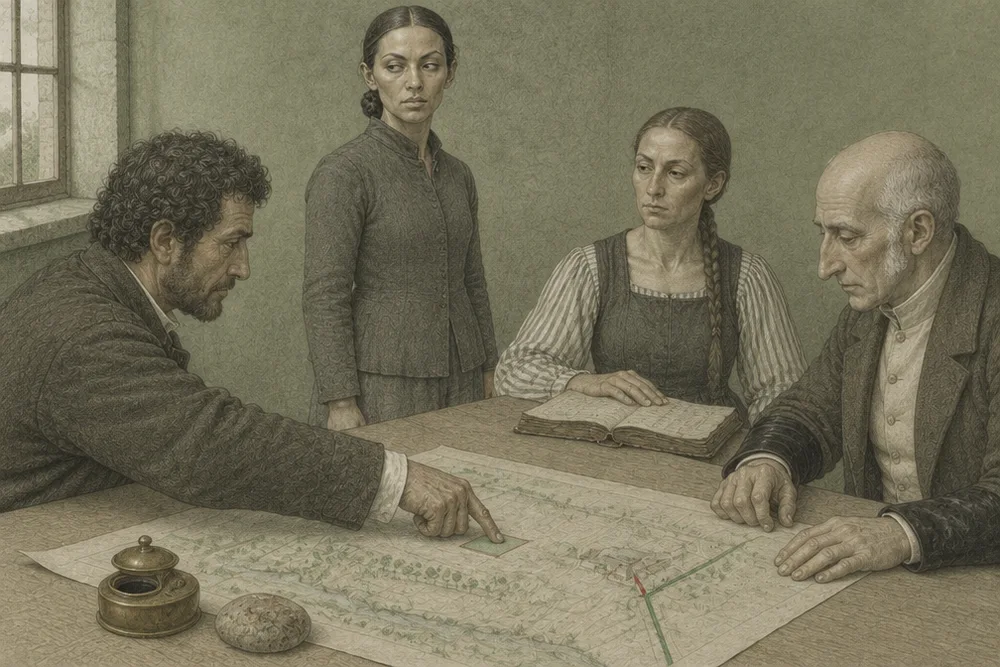
“No one is asking you to award us the land,” Flavia said. “We are asking you to count the cost of making the house uninhabitable.”
Bassi glanced at the other commissioners. One looked down at his figures. Another turned the chipped cup by its handle. “If we count every inconvenience as a charge against the works, the works will never begin.”
Outside the office window, carts rattled over the western road toward town. The sound rose, paused at the gate, and went on. Flavia felt the few coins in her pocket strike one another when she shifted her weight. She had been paid by measured day since she corrected the first survey, and there had been too few days lately.
“Then let us count what the works require,” Vezzi said. His voice was dry and precise, the voice he used when a level’s bubble would not settle. “They require that the Bellori household leave before excavation. Whether the record calls that relocation, removal, or an inconvenience, the crew cannot dig through occupied rooms.”
Bassi’s mouth tightened. “Engineer, you requested an allowance for a vacant site.”
“I requested a cost estimate based on the record I had.” Vezzi’s drooping eyelids lowered to the drawing. “The record is now contradicted by the register.”