The Road That Ended at Home
Chapter 26 · Brass on Brick
Page 260 of 276
Chapters
The chamber stood open to the morning, its new brickwork still the color of a cut loaf. Beyond it, the feeder ran in a shallow curve through ground where the old tollhouse yard had been. Flavia Bellori set her level case on a plank and looked from the chamber to the road, then to the place where the house’s front wall had once cast a strip of shade. Only the permanent reference remained unset. Without it, the works could carry water and still fail the survey: every height would be a number without a trustworthy beginning.
Vezzi arrived with the benchmark wrapped in oiled cloth. He was lanky even when standing still, shoulders sloped beneath his pale waistcoat, black sleeve guards buttoned at his wrists. He unfolded the cloth and showed her the brass disk, its central point worn bright from handling. A stamped number circled the rim. “You’ll want the abutment,” he said, nodding toward the chamber’s western end. “The inspection found it sound.”
“Sound now,” Flavia answered. She led chin-first toward the masonry, long forearms held close so she would not brush the wet mortar. Her gray jacket had faded at the elbows; ink darkened both cuffs. She ran a fingernail along the joint where brick met brick, then crouched to sight the courses. The abutment rested on a broad footing, deeper than the feeder trench and beyond the soft fill that had ruined the first proposed site. Its face was dry. No hairline crack showed in the pale morning light.
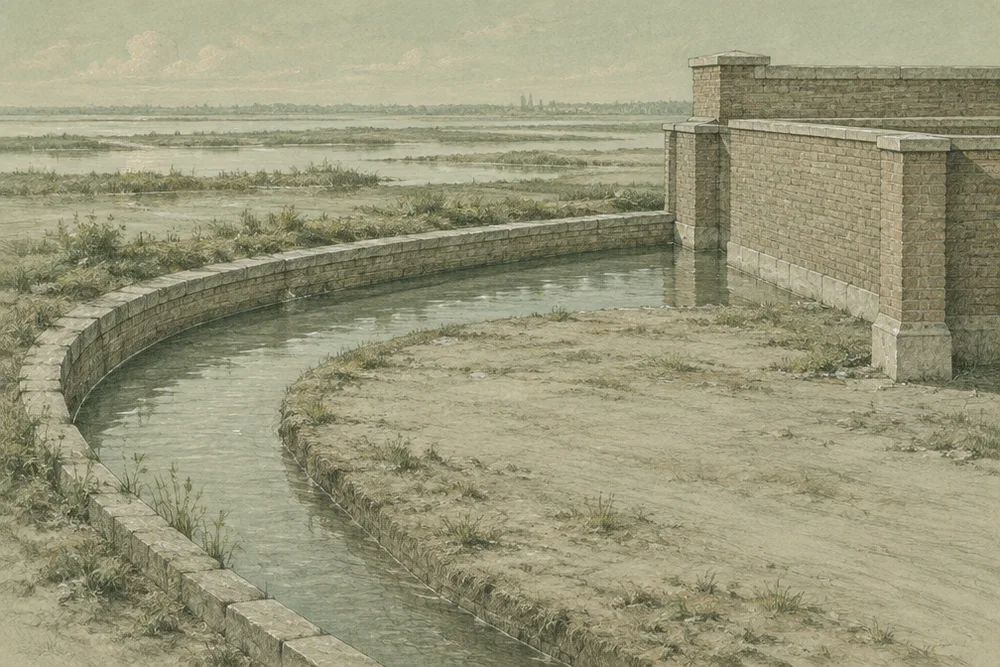
“We set it here, and the map begins here,” Vezzi said. His elbows tucked against his sides as he watched her. “Provided the tie is checked before the old stone comes out.” The tollhouse notch, cut into the sill beneath their former door, still marked the survey’s original datum. The masons were due to lift that sill today. The house was already gone, its rooms reduced to sorted piles of timber and brick, but the stone remained under a tarpaulin beside the work lane.
She fetched the level and tripod. Her instrument debt had been paid, but every tool still carried the sensation of something she could lose. She fitted the legs together, tightened the wing nuts, and planted the points in the compacted earth. A mason’s boy offered to hold the staff; she sent him to fetch a second peg instead. The reference had to survive not merely this morning but years of frost, flood and official indifference.