The Road That Ended at Home
Chapter 15 · Water That Will Not Rise
Page 147 of 276
Chapters
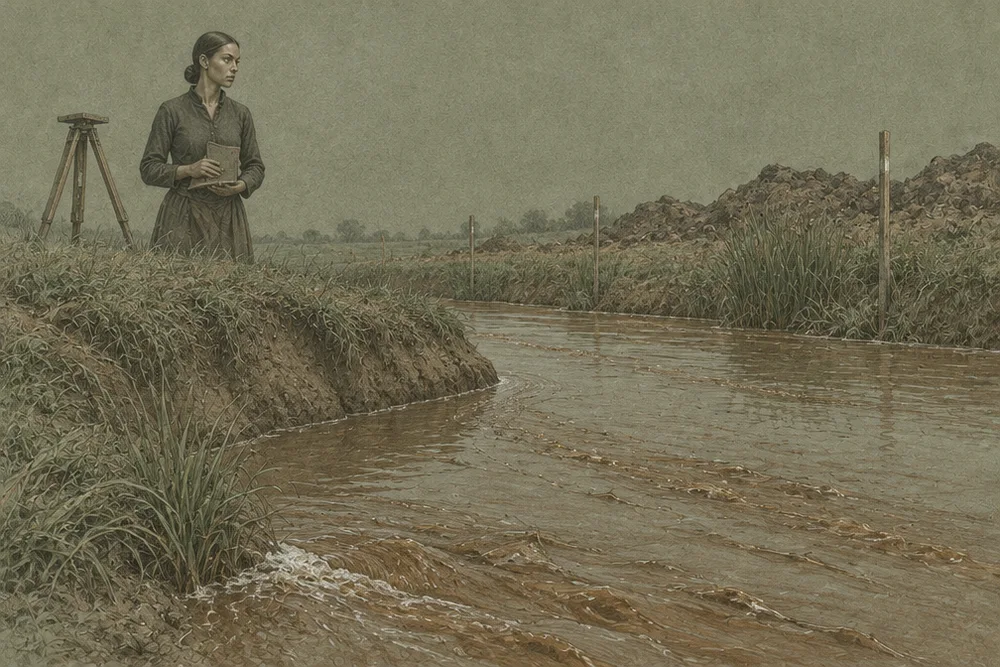
By the time Flavia reached the trial ditch, the morning mist had lifted from the former marsh and left every reed tipped with water. The cut ran from the feeder toward the garden plots, a narrow brown line between banks of fresh spoil. Its end stopped short of the nearest well, where a plank bridge had been laid for the carriers. Beyond it, Rina’s garden beds lay in orderly ridges, the onions already showing green. Two men from the commission stood beside the gate with their coats buttoned against the damp. Engineer Vezzi had chosen the place where he could see both the ditch and the well without leaving the firm path.
“No one opens it until the level is read,” he said. He held the measuring staff while Flavia set the instrument on its tripod. The legs sank a little into the peat; she pressed them down until the bubble settled. Cesare stood back on his heels in his reed cape, his patched waders dark to the knee. His old canal keys were gone, but he had been allowed to attend as a witness. Rina waited near the well, pigeon-toed, sleeves rolled, her checked kerchief knotted at the nape. She kept looking from the water gate to the bucket beside her. The bucket was clean and empty.
Flavia took the first reading, called it aloud, and entered it in the field book. Vezzi repeated the number for the clerk. They checked the gate sill, the ditch bottom, and the well curb. The figures agreed within the small difference she expected from settling ground. A mason’s boy held the staff while she sighted the feeder’s fall. She found no error in the grade. On paper, the line should carry water steadily to the gardens, seep into the soil, and replenish the shallow wells. It was the simplest answer they had left after the direct route threatened the Bellori kitchen and the longer contour met a wall of private leases. Flavia shut the book and looked at the gate. “Let it run,” she said.
The gate lifted with a groan of iron against brick. Water slid through the opening in a shallow sheet, then gathered itself into a brown tongue and moved down the cut. The first rush carried loose clay and straw. It made a soft scraping sound against the ditch bed, quiet under the distant clank of a cart on the embankment. Flavia watched the surface pass the marked stakes. It reached the bend, slowed where the bank broadened, and continued. A thin line of foam caught against a tuft of grass. The clerk bent to note the time.