The Road That Ended at Home
Chapter 11 · The Courtesy Barrel
Page 105 of 276
Chapters
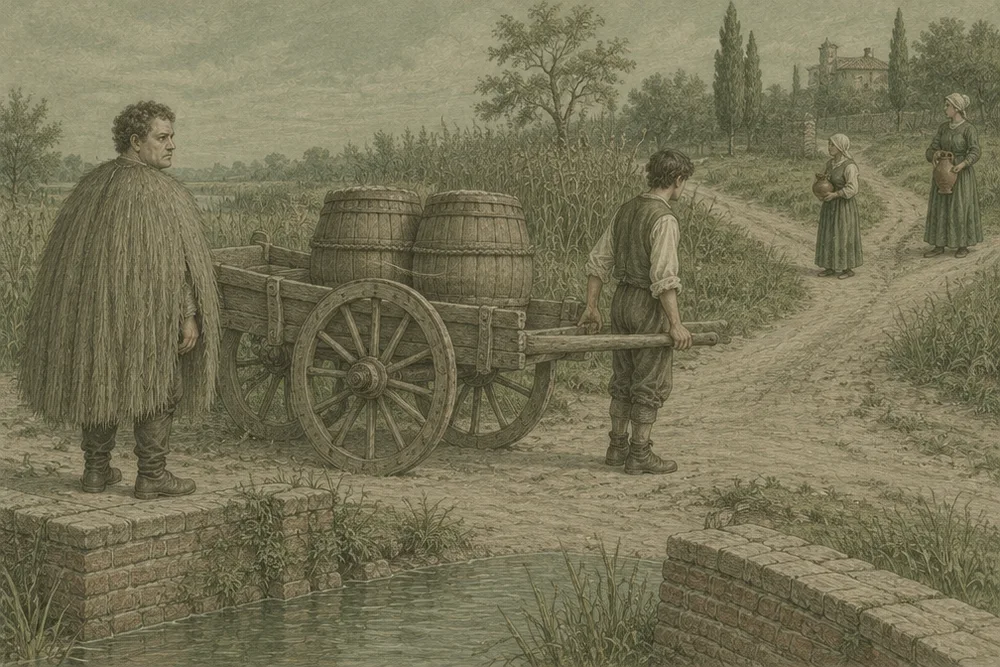
By the time the commissioners’ cart had gone uphill, the work had stopped pretending it was only waiting for better weather. Men sat on the bank with their shovels laid across their knees. The measuring chain hung in a coil from a stake. At the canal gate, Cesare Virelli’s keys rested in his pocket, heavy as a promise he had not made. He watched the water slide between the brick cheeks and thought of the dry wells south of the embankment. The revised line was not yet approved. Flavia had brought in her new levels and her register of households, and the engineer had taken both to the town office. Until he returned with an order, no one wanted to put a spade into ground that might be condemned or paid for twice. The gardeners could wait a few days for a ditch. They could not wait for water. Cesare had arranged a courtesy allotment for the household with the biggest cistern: the Bellandi farm, whose owner had lent the commission a wagon and whose stone trough stood beside the lane. One barrel filled from the canal could be carried to the poorer plots, the understanding went, if the Bellandis did not need it. That morning he saw their servant, Piero, rolling two full barrels past the turn to the gardens. They were not going to the farm. The barrels were marked with a cooper’s chalk sign and bound with rope for the market road. Cesare called after him. Piero paused, one hand on the cart shaft. “Master Bellandi says these are his allotment,” he said. “He’s sold them to the inn.” The water rocked against the staves. Cesare looked past the cart to the gardeners’ path, where women were already waiting with smaller vessels, some no larger than cooking pots. He did not raise his voice. “Take them back.” Piero shrugged. He was a hired boy, not the man who had made the bargain. “The inn has paid.” Cesare felt the keys press against his thigh. The new works were stalled; the old arrangement was failing in plain daylight. And the first thing a man with money had done was turn a shared favor into a sale.