The Road That Ended at Home
Chapter 8 · Names at the Washstones
Page 76 of 276
Chapters
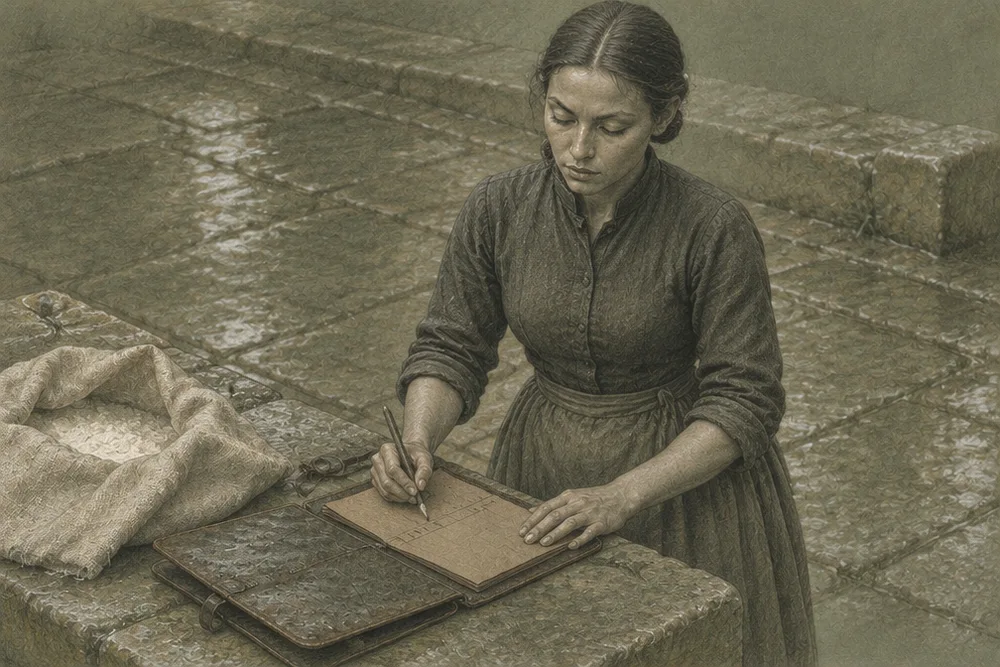
By the time Flavia reached the washstones, the argument had acquired a queue. Women stood with pails between their shoes, some empty, some holding an inch of water gone gray with silt. Rina was at the head, rolled sleeves dark to the elbow, her checked kerchief knotted tight over her cropped hair. She had set a slate on the stones and was writing names with a stub of chalk.
“You said the turn was fair,” a woman told Cesare. Her pail was a painted oil tin with a wire handle. “My boy waited yesterday, and then the keeper’s cousin took two measures.”
Cesare rested his weight back on his heels. In patched waders and a reed cape, he looked too broad for the narrow strip of paving. “His cousin brought the measure back.”
“After filling his own barrel.”
Rina glanced up at Flavia. Her split eyebrow made the look seem sharper than it was. “We need the households, not only the people who can get a barrel to the gate. The ration book names the allotments. It does not name the ones who carry.”
Flavia held her field case against her hip. The leather had softened where rain had found the seams. Since the failed trial, she had been thinking of water as a question of levels: where it entered, where it stopped, what held it back. Here the question stood before her in worn shoes, asking why a turn had been called equal when the vessels were not.
“Write them,” she said.
Rina gave the slate over. “You have a pencil. I have a list and no place to put what it means.”
Flavia took the chalk. The first woman gave her name as Lucia Sarti, then named the widow in the lane behind her, who sent a child with two small jars. Another spoke of three brothers sharing one roof and one shallow well, though the ration sheet counted them as a single allotment. Names came with corrections, kinships, directions, and objections. Flavia asked each woman to say which door she meant, and whether the household slept there through the winter or only came for the garden season.
The answers did not fit the slate. Rina found an old flour sack and spread it over the stones. Flavia began a fresh list on the brown paper inside her case, leaving space for each door and for the source of what she wrote.