The Road That Ended at Home
Page 79 of 276
Chapters
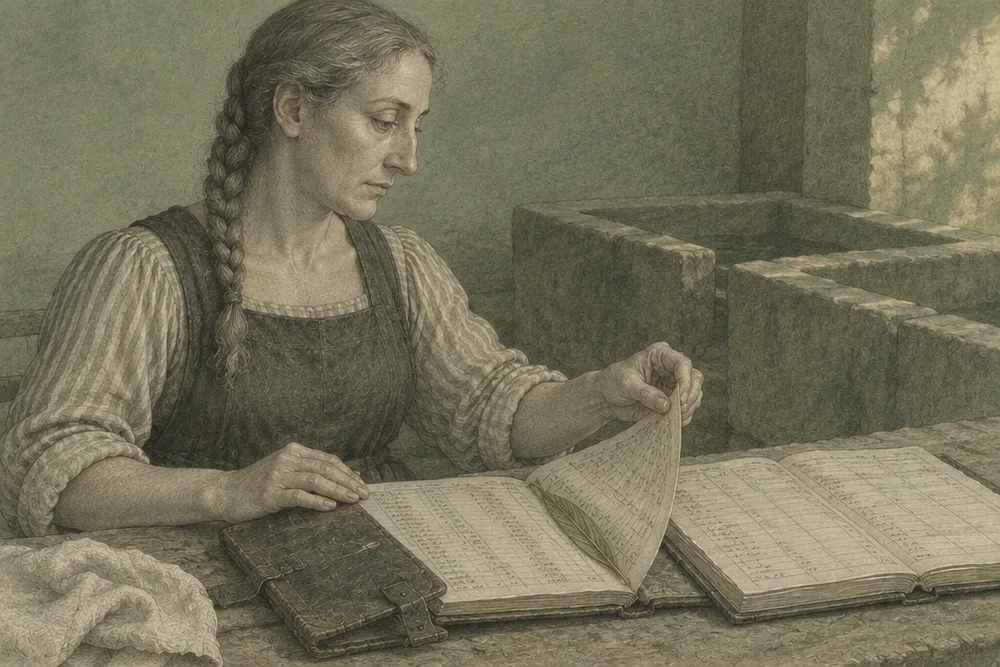
Agnese came down from the tollhouse near sunset carrying a bundle wrapped in a clean towel. She was tall and erect, even when she lowered herself onto the bench beside the washstones. Her silver braid lay over one shoulder; the dark bib of her apron was wet where she had rinsed clothes before coming.
“You have written half the district,” she said, looking over Flavia’s papers.
“Only the houses near the proposed feeder.”
“That is what I said.” She untied the towel. Inside lay a thin, cracked book with a leather cover and a brass clasp tarnished almost black. “You asked me last week whether the old toll ledgers still existed.”
Flavia stopped writing. “I did.”
“This is the one I kept when I worked the gate. The office had its copy. This was mine.” Agnese laid it on the bench. “I did not give it to you before because I thought you wanted to win an argument, not find out what it said.”
The cover smelled faintly of smoke and damp storage. Flavia opened it carefully. The pages were filled with the narrow, upright hand she recognized from her mother’s labels on jars and folded linen. Names ran beside dates and amounts: cart tolls, passage fees, repairs to the gate, receipts for keys. Some lines had a mark in the margin, a little cross or hook.
“These are not land payments,” Agnese said. “People brought what was asked when they crossed the road, or when they were allowed to use the rooms. The tollhouse was public ground. The district let families lodge there when the station was no longer staffed. It did not make the rooms theirs.”
Flavia traced one line without touching the ink. “Permission to occupy.”
“That is the phrase they used. Permission to occupy, revocable when the road required it.” Agnese turned to a page with a pressed reed leaf caught between the paper. “Here. Bellori. Your grandfather paid for passage and firewood. Not for the house.”
“But we have lived there all my life.”
“I have lived there longer than you have. I know.” Agnese’s voice held no softness, but neither did it accuse. “A long stay is a fact. It is not a deed.”
Flavia looked at the register beside the ledger. One book recorded the public function of the station; the other recorded the people who had made rooms and lives inside it. Neither erased the other. On her survey, the first had been drawn with exactness and the second omitted altogether.
“We should enter the permission,” Agnese said. “And our names. Do not make us owners because you love us. Do not make us absent because the office prefers it.”