The Road That Ended at Home
Page 68 of 276
Chapters
He looked at the pale line of the channel and the many dark lines branching from it. “Because a list makes the water belong to whoever is named first.”
“And without a list?”
“It belongs to whoever can find me after dark.”
By the time they reached the end of the lower ditch, the lantern flame had shrunk to a blue bead. Cesare pinched it out to save the oil. The moon gave enough light to find the embankment road, a pale raised strip above the reclaimed marsh. They turned west, following the service track toward the tollhouse.
Flavia kept her field sheet folded in one hand. “How long have you made these turns?”
“Since the first dry spring after the east gate was repaired.”
“That was before the drainage commission.”
“Yes.”
“You knew the proposed line would cross the tollhouse.”
Cesare stopped. The road beneath his boots was dry on top and soft below. In the dark he could just make out the nearest survey stake. It stood where the embankment widened, its white head like a small bone.
“I knew there was an old boundary there,” he said.
“You knew what building it marked.”
He had thought he could say no and have the night swallow it. But Flavia was looking at him as if she had already heard the answer in his first sentence.
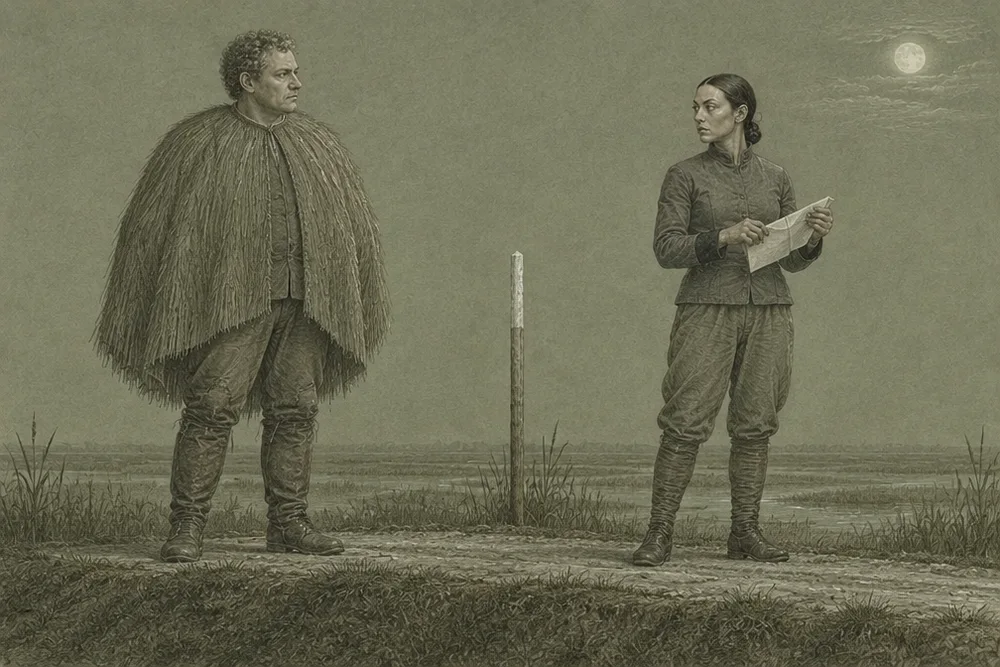
“I knew the tollhouse line,” he said. “I recognized it when you came back with the bearings.”
“And you let me believe you didn’t know where the benchmark belonged.”
“I told you I didn’t know where the benchmark belonged.”
“That is not an answer.”
“No.”
She folded the sheet carefully, smoothing the crease with her thumb. She did not raise her voice. “Why did you come with me?”
He remembered the first morning: her borrowed level, the brass benchmark, the instruction to follow the embankment and turn back when the bells sounded. He had seen the road she would take. He had expected the bells to pull her east and back again, then send her to the villages. He had hoped she would leave the last bearing untested. He had hoped because the tollhouse was occupied and the map called it empty; because if she found that out, the proposed channel would cut through a kitchen; because the unauthorized ditch he had kept alive might be exposed along with it.
“I thought you might stop before tracing the last line,” he said.
“You wanted me not to find the house.”
“I wanted the house left standing.”
“Those are not the same.”
“I know.”