The Road That Ended at Home
Page 34 of 276
Chapters
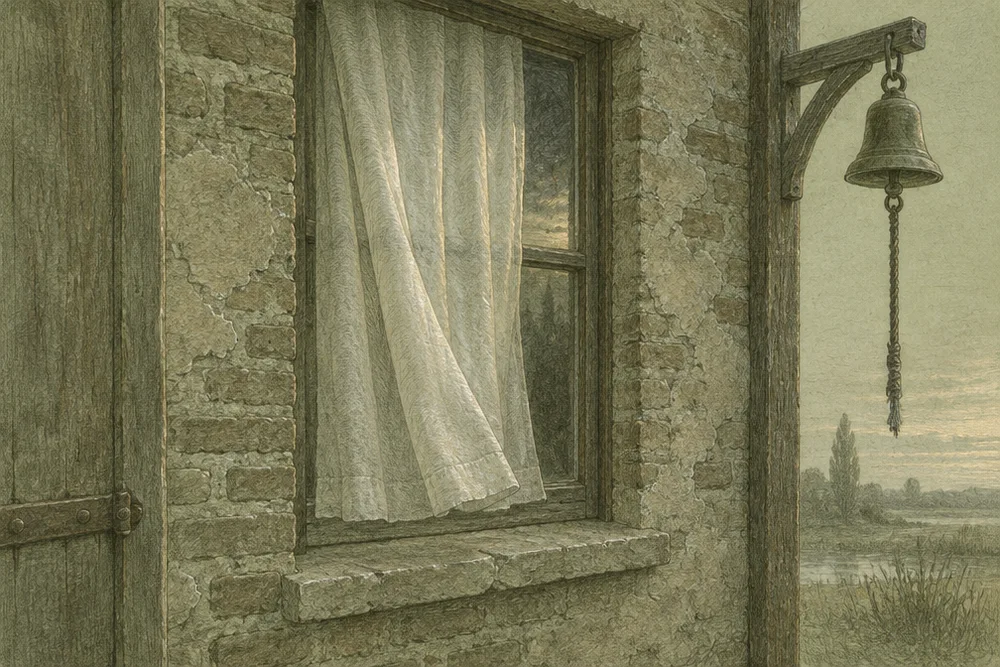
On the far side, the track rose past a low wall. From its crest, the settlement opened into view: several brick houses, a small workshop, a long outbuilding with a sloped roof. No church tower stood among them. Behind the houses, at the end of the road, was a low brick building with what looked like a sag in its roof. A post stood before it, and a metal bell hung from the crosspiece. A rope dangled beside the post, dark from handling.
The bell moved once in the wind and sounded again.
Flavia stopped. The last bearing on her sheet ran directly to the low building. From here it seemed to meet the door. She turned the compass and checked. The needle and the line agreed. The sight was not perfect—the roofline and the post made a narrow gap where she could place the center—but she could set the rod beside the door and read the angle. The benchmark’s destination, she thought, might be this old station. It was the only solid point at the end of the line.
‘This is the fifth?’ she asked.
Cesare stood still behind her. ‘It may be.’
‘You have heard that bell before.’
‘Yes.’
‘And you brought me here.’
‘You came here.’
‘You chose the path.’
‘It keeps the sightline.’
She looked at the building. The old toll station was marked empty on the sheet. A little farther down the reserve stood a road marker, and from here both points fell close to the same bearing. At this distance, the structure seemed abandoned. Its door was shut; the windows were dark. She could not see anyone in the yard.
A shape moved behind the small window beside the door. Flavia took one step forward. The curtain shifted and fell back into place. She saw no face, only a pale rectangle disappearing behind the glass.
‘Someone is there,’ she said.
‘Perhaps.’
‘You knew.’
‘I knew the bell.’
He would not look at her. Flavia stood with the field sheet in one hand and the compass in the other. The last numbered line had found its place, but she had not yet attached it to a village, a tower, or a person. The bell hung silent over the low roof. In the doorway’s shadow, the house looked less like a mark on a plan than a threshold waiting to be crossed.