The Road That Ended at Home
Page 27 of 276
Chapters
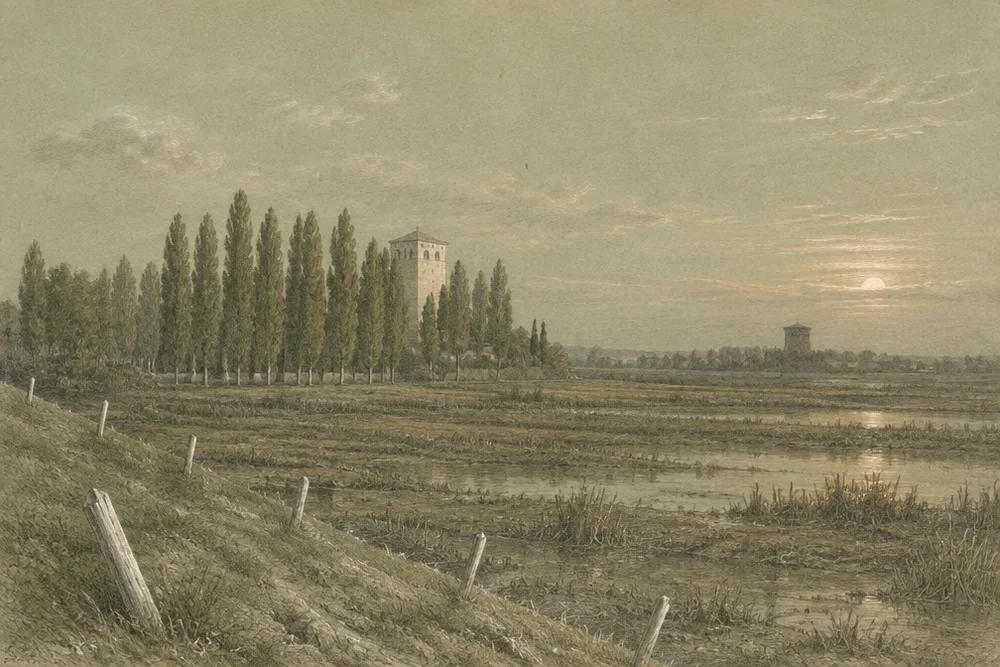
They walked west along the road above the drained ground. To their right, the former marsh spread out in gray-green patches, reeds cut close and water pooled in the old hollows. To their left, the new embankment fell toward garden plots and shallow ditches. A line of white stakes marked its outer slope. Some stood straight; others leaned at different angles, their tops tracing no consistent height. Flavia noted them as she passed, though there was no room yet on the sheet for another correction.
The bells came again. This time the first and second overlapped. The first had a bright, sharp edge; the second sounded more hollow, as if it had passed through a roof before reaching her. She stopped, listening. In the distance she saw the top of a tower appear beyond a row of poplars, square and pale against the sky. Another tower showed farther west, darker and lower.
‘The nearest one is the first,’ she said.
‘Perhaps.’
‘The sound is stronger.’
‘The wind is behind it.’
She turned her head and found the wind on her cheek. It had shifted while they crossed the gate. She made a note to check the visible towers against the bearings rather than trust the loudness. The first bearing ran north by west from the east crossing; the tower beyond the poplars sat almost on that line. The second bearing angled farther west, toward the darker tower.
Cesare walked ahead by a few paces, his patched waders making soft, sucking sounds where the road’s edge remained damp. He glanced back only when she stopped. He seemed to know precisely when she needed a view, although he still professed ignorance of the benchmark’s destination. The suspicion that he was withholding some piece of the route had settled in her like grit in a shoe.
‘If you know the towers, name them,’ she said.
‘San Pietro. Then Santa Lucia.’
‘You could have said so before.’
‘You did not ask their names.’
‘I asked where the benchmark belongs.’
‘And I do not know.’
He turned away again. Flavia could not decide whether to believe him. He had not been sent by Vezzi, as far as she knew. The canal keeper had appeared at the office the previous afternoon, heard of the trip, and insisted he had business east. If he knew no more than he claimed, he was an inconvenient companion. If he knew something, his care in preserving the sightline was a warning.