The Road That Ended at Home
Page 264 of 276
Chapters
No one spoke while she worked. A wheelbarrow rattled at the far end of the site and stopped. Beyond the bank, the reclaimed plots showed rows of early greens. There was no house left to cast shade there. The land lay open to the road and the works, but the record beside Flavia’s elbow retained the name of the family that had lived in it.
When the lead cooled, she set the staff against the mark and took a final reading. The number was steady. She entered it, added the time and the names of those present, and drew a small circle around the benchmark’s position on the plan. The circle did not blot out the old notch; a fine line joined the two, labeled with the measured difference.
“Now it can be found again,” Nello said. He had come back from the cart with dust on his freckles and the staff still in hand.
“If the drawing is kept,” Vezzi said.
“And if it isn’t,” Flavia replied, “the mark will still be here.”
Vezzi examined the finished mark, then turned to the tie sheet. He checked the arithmetic once more and signed beneath Flavia’s observations. His signature was compact and pale, the ink thinned where his pen had run low. “I’ll attach this to the acceptance plan,” he said. “The old datum will remain in the record.”
“With the occupancy schedule.”
“With the schedule.” He spoke as if the distinction had been settled at last, though Flavia knew a signed page could be filed badly, copied incompletely or made to disappear beneath newer papers. She drew a duplicate in her own book and noted where the original would be kept. It was not distrust alone that made her do it. A surveyor’s work was to leave a route back to the fact.
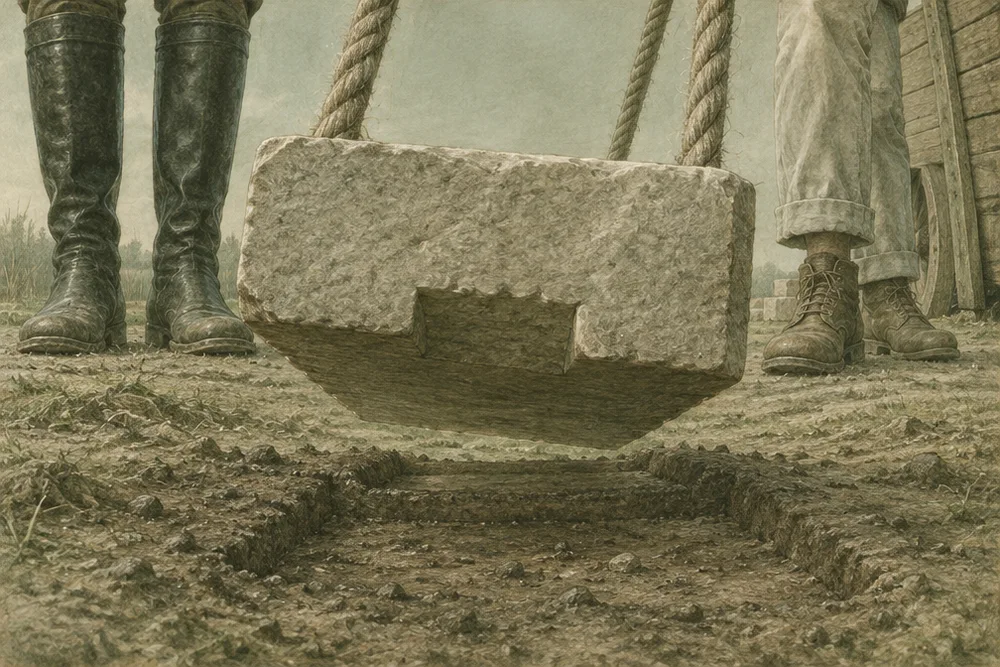
The masons began to raise the sill onto the cart. A rope creaked; the stone lifted one handspan, exposing the dark earth beneath. Flavia watched the notch pass level with her knees. She had expected a sharp feeling at its removal, a single wound. Instead she felt the measured click of a chain being drawn through a pulley, one link after another. The house had been dismantled by decisions, not by one blow.
Agnese had reached the wash shelter. Two upright posts and a lintel remained from its first construction; the rest had been repaired with scavenged boards. The shelter stood beyond the chamber’s work lane, near the path used by women carrying water. Agnese propped the door beside it and studied the hinges. The shelter’s frame had once held a plank screen, never a proper door. The old door was wider and heavier, but its boards were sound.