The Road That Ended at Home
Page 237 of 276
Chapters
Rina carried no bucket. She had brought a folded sheet of paper, its corners softened from being handled. She looked first at the chamber, then at the line. “Before you open,” she said, “we need to settle what a turn means.”
“A turn means the amount written on the board,” Flavia said. She pointed to the slate propped beneath the shelter eaves. “One standard measure for each household draw, with the drinking reserve held back before any garden allotment.”
Rina unfolded her paper. Names and marks filled its face in three uneven columns. “And this?”
“Your list of households.”
“No. My list of vessels.” She tapped a line with her finger. “If a turn means filling whatever a family brings, this little barrel counts as one and a barrel four times its size counts as one. The slate says ‘standard measure.’ How will you make sure they get the same amount?”
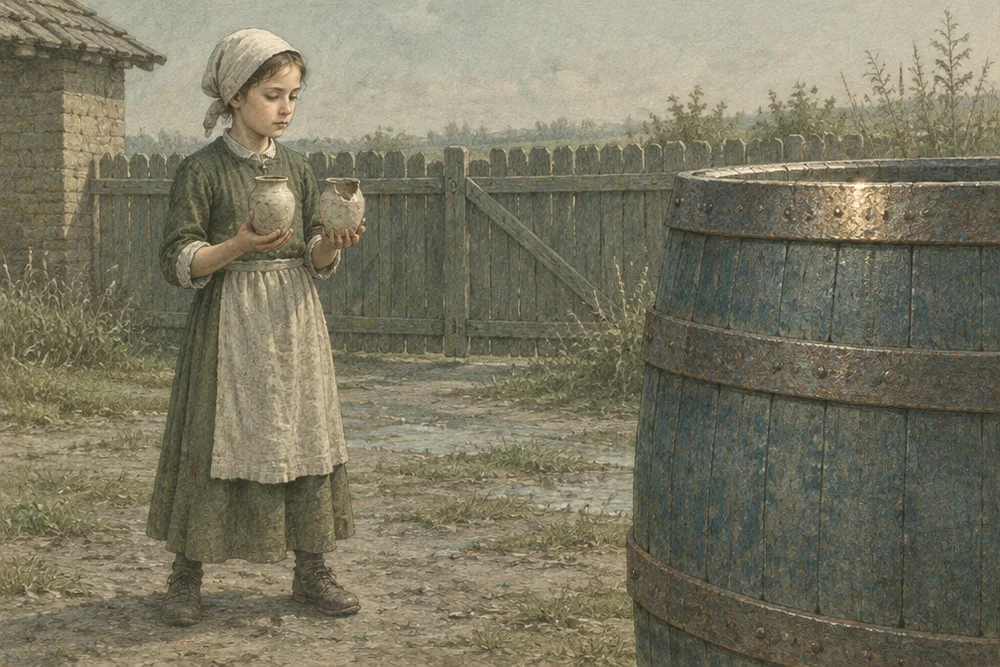
The line behind her stirred. Several people shifted their empty buckets from one hand to the other. The larger barrel belonged to a prosperous household that had already tried to resell part of its old allotment. It was painted blue, with iron hoops broad enough to catch the sun. Beside it stood a girl holding two chipped earthen jars, light enough empty for her to hold both, though she could carry only one at a time when they were full.
Flavia took Rina’s sheet. The notations were rough but legible: household marks, vessel sizes, and the number of trips people could manage before the path became dark. She had seen Rina use the same method at the washstones, dividing complaints into drinking, washing, and irrigation. The commission’s form had no column for the strength of a carrier’s arms, or for how far a household lived from the drawpoint.
“We could count people instead of households,” Flavia said. “Then a household of six would draw six times as much as a household of one.”
“If each household takes one barrel, the family with the great barrel gets four times what the girl gets. There is no fair count that ignores how much water is in the thing.”
Vezzi stepped nearer. “We can weigh the barrels.”
“They are not all here,” Rina said. “And next week they will be different ones.”
A man in the queue lifted his chin. “I have paid for my own barrel.”
“Then you may carry it,” Rina said. “You may not use it to make the water yours.”
The man began to answer, but Agnese Bellori came from the wash shelter with a damp rag over one shoulder. She wore her dark bib apron over striped sleeves, her silver braid lying neatly down her back. She stood erect, even after a morning of carrying boards and scrubbing brick dust from the shelter’s bench.