The Road That Ended at Home
Page 234 of 276
Chapters
The foreman sent one mason to fetch a sounding bar. The rest began sorting stone by size instead of carrying it to the failed excavation. Their movements were slow with caution, but they were movements toward a foundation that might stand.
Flavia took the signed sheet to the rise and pinned its corner beneath the level case. From the western road, the higher site was only a slight lift in the land, three steps by Nello’s measure. From the marsh side it looked more substantial: a narrow ledge between the firm lane and the lower plots, with enough fall for the feeder and enough ground beneath it to carry brick.
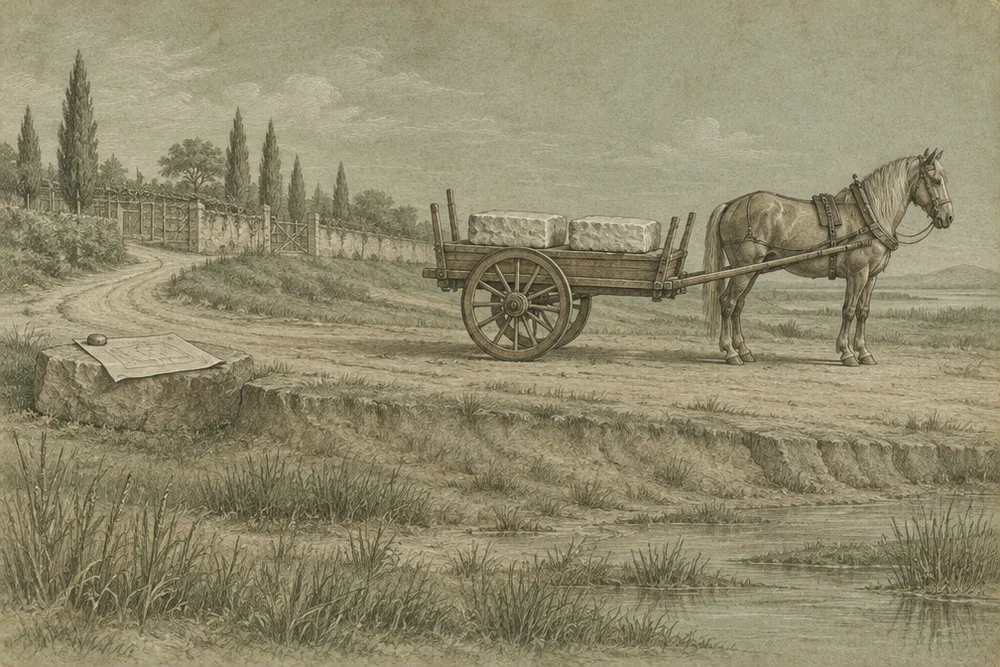
Nello walked the proposed approach again, this time with the cart loaded with two stones from the sorting pile. The horse leaned into the traces. At the turn he steadied the load with one of his oversized hands, and the wheels followed the dry line without sinking. He stopped where the chamber would stand.
“There,” he said. “The cart can wait without blocking the way.”
Flavia marked the stopping place. A carrier could come from the west, set down a barrel, draw water, and return along level ground. The chamber would be beyond the old tollhouse yard, on public works ground, but its path would cross a lane people already used. She put that fact on the sheet too.
Vezzi came up from the lower cut, wiping peat from his cane. “The bank must be tested tomorrow. Until then, no excavation.”
“Agreed.”
“If it fails, we stop again.”
“Agreed.”
She had spent months being measured by how little time her questions cost. Now each delay had a line, a reason, and a price written beside it. The workmen knew there would be no digging that day. Nello knew the approach had been seen. Vezzi knew the levels did not depend on an empty house or a convenient fiction.
Flavia rolled the plan carefully, leaving the new line visible at the top. The final alignment held within budget—not because the ground had yielded, or because the people beside it had been treated as blank space, but because the design had been made to fit what was there.