The Road That Ended at Home
Page 215 of 276
Chapters
At the chamber site, a thin film of water ran along the rut left by the survey cart. Flavia planted her boot beside the proposed corner and felt the turf shift under her weight. She looked down at the ground, then at the drawing. The line was clean on paper. The land beneath it had not yet answered.
The foreman, Bassi, had a compact face and a gray mustache that vanished into the collar of his coat. He held his hat in one hand and the order in the other, protecting both from the rain with the same care. “We have four men paid for the day,” he said. “If we stand idle, they still need their bread. You marked this place.”
“I marked it for inspection,” Flavia said. She took the folded plan from him and opened it against her knee. “The chamber corner is here. The first cut should be there, at the stakes.”
“That is what the drawing says.”
“The drawing says where the work is meant to be. It does not say the ground is sound.”
Bassi glanced at the laborers. They had lined up their spades beside the ditch. One was young enough to be Nello’s brother; another had a bandage wrapped around his thumb. Their faces were patient, but the patience was the kind that had to be renewed with each delay.
Engineer Vezzi had approved the alignment after reviewing the levels and the low-flow calculations. The drawing had been returned with his initials and the estimate of brick, lime, and labor. Flavia’s marks were all over it: a correction to the fall, a note about the existing culvert, a cross-section at the gate. She had argued for the line around the kitchen and through the garden leases. This chamber was supposed to be the reliable end of that compromise, the place where water could be drawn without the household wells having to depend on seepage through whatever soil remained.
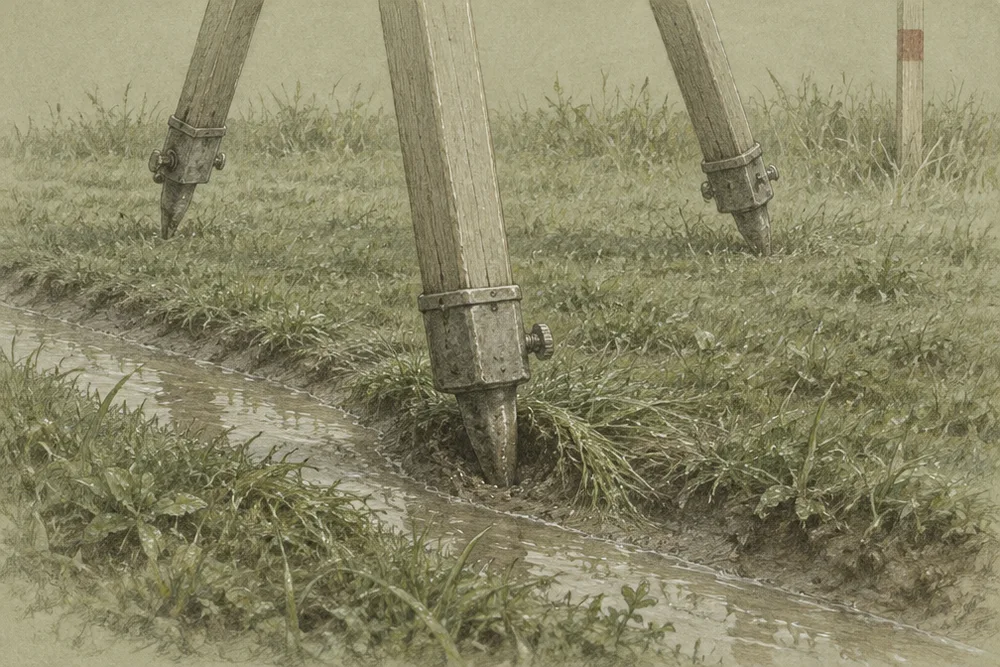
She set the plan on a crate and took out the level. The instrument’s tripod legs pressed into the wet turf. She sighted across the proposed chamber toward a stake at the west approach. The bubble settled, then trembled and slid off center as the ground beneath one leg sank a fraction.
She reset it. The bubble moved again.
“Your tripod is on soft ground,” Bassi said.
“Yes.”
“Then put it on firm ground.”
Flavia looked toward the cart track. The nearest firm patch lay higher, above the marked boundary, and gave a different angle to the channel. She did not yet know whether that difference could be accommodated. A few inches of fall mattered here; a careless change could leave the drawpoint starved in a dry week, or drive water against a bank meant to hold it.