The Road That Ended at Home
Page 21 of 276
Chapters
Cesare waited while she worked. He stood with his hands tucked into the folds of his reed cape, his broad face turned toward the east. The wind had flattened the cape against his shoulders. He looked older when he was still, she thought, not because of his years but because he seemed to be carrying the weight of every channel he had ever been asked to keep open.
“How far to the east gate?” she asked.
“A little more than an hour if the road stays passable.”
“And if it doesn’t?”
“Then we find out how far mud can delay a person.”
“That sounds like experience.”
“It is.”
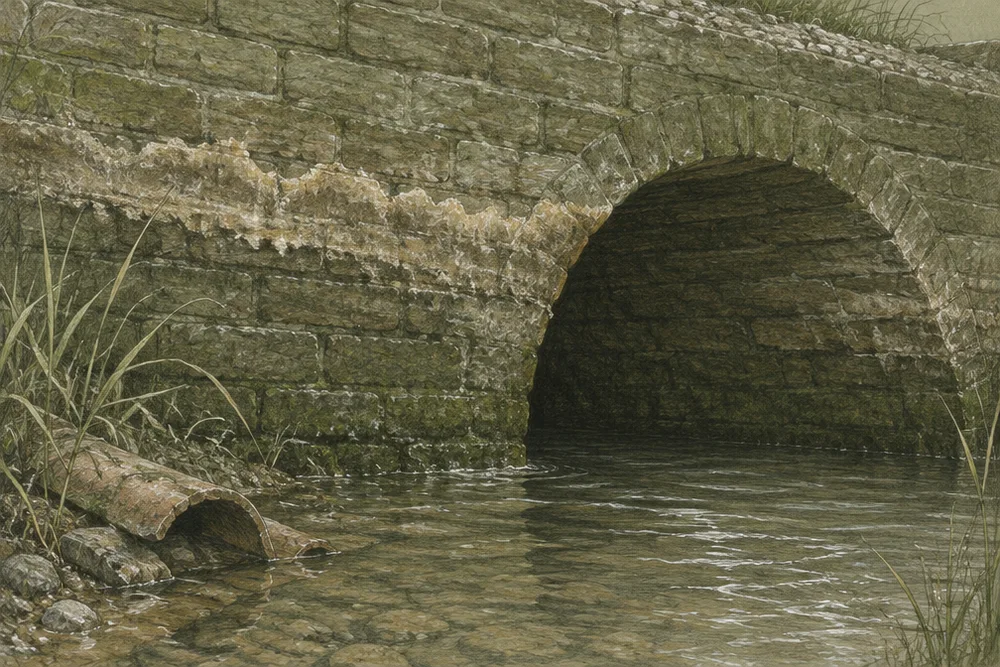
They went on. As the light began to lower, the road passed a small brick culvert. Flavia examined its mouth, where water had left a brown line above the present flow. She wrote the height and the direction of the stain. The culvert’s bricks had been laid in crossed courses, some edges worn smooth by years of water. Beside it lay a broken tile that might have come from the old toll road, or from a later repair. She left it where it was.
Beyond the culvert, she could see a second church tower, shorter and broader than the first. No bell sounded. In the distance, a cart moved along the western road, its wheels dark against the pale ground. The driver lifted one arm when he saw them, then continued without turning.
Flavia counted the remaining stakes. Three were properly marked; two had been driven at uncertain intervals. She checked each one’s position against her field notes. The sequence had no visible end. It continued toward the east, where the embankment narrowed and the ditch bent away from it.
“You said there were gates along this route,” she said.
“There are.”
“How many?”
“Enough to make counting them useful.”
“That is not a number.”
“No.”
She closed the field book with her thumb between the pages. Her hands ached from holding the instrument, and the damp wind had worked through her cuffs. The road above the marsh had begun as a simple line. By now it had stakes that would not hold, paths the map did not show, a garden with a failing well, and a canal keeper who answered questions as if each answer might open a gate he preferred shut.