The Road That Ended at Home
Page 196 of 276
Chapters
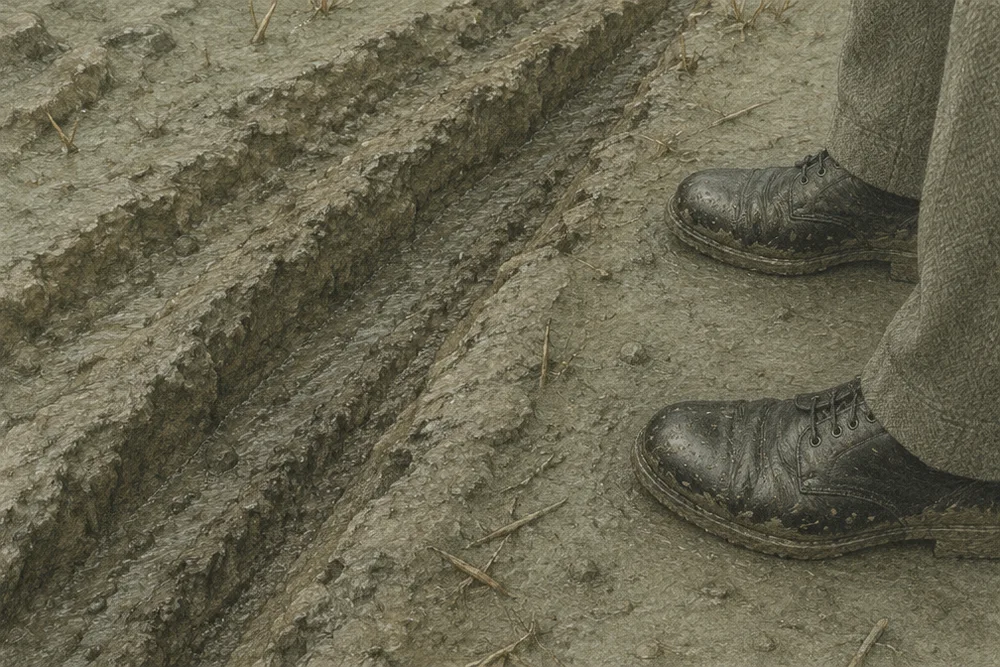
“That is not the ordinary route,” Bassi said.
“It is the route when the well gives mud,” Rina replied. “The well gave mud three mornings this week.”
The carrier lifted the yoke again. The pails bumped her hips. Rina walked beside her, not taking the load, and the officials followed. A short path on the plan became a long passage around beds, a narrow bridge over a drainage cut, and a walk along the embankment where no cart could turn. When they reached the standpipe, the carrier set down her burden and flexed her fingers one at a time.
Flavia took out her field book. The route from the failed well to the public drawpoint was longer than the map’s scale suggested, because the map measured ground and not the weight carried over it. She wrote the distance, the crossings, and the number of steps between the bridge and the pipe. Rina named the households that used the route, including two whose doors were missing from the occupancy register.
“If the feeder is laid as drawn,” Rina said, pointing toward the green line now hidden behind the embankment, “these people still need a way to reach the drawpoint. The works cannot put a ditch where the lane is.”
Bassi’s shoes were already splashed. He looked at the carrier’s pails, then at the muddy track. “The drawing shows a culvert.”
“It shows a line,” Flavia said. “Not a turning place. Not a path for the people who bring the water.”
The official nearest Vezzi took off his hat and wiped his forehead. They had walked less than a mile. The woman with the yoke was already returning, the empty pails swinging lightly now. Rina watched her until she had crossed the bridge, then led them toward the Bellori yard.
The tollhouse yard had been swept since the last rain. Agnese kept it usable even when no one paid her to do so: washstones scrubbed, lines mended, a shallow channel cleared to carry rinse water away from the door. The old tollhouse stood at the western edge, its stone notch where the benchmark had once been cut still visible beneath the sill. The front wall faced the road; the yard opened toward the garden leases.
Three laundresses were at work. One beat a shirt against a smooth stone while another wrung a sheet between them. A tub stood on a pair of blocks so it would not sink into the soft ground. The third woman had piled folded linen on a plank bench, sorted by household and marked with small scraps of thread.