The Road That Ended at Home
Page 182 of 276
Chapters
Agnese closed the ledger. “You know the difference between a line on a plan and a life lived beside it. I taught you to keep accounts. Count the whole thing.”
Vezzi waited without speaking. The stamp’s blue ink was beginning to dry.
Flavia took a fresh sheet. “I’ll include the ledger as evidence of occupancy, not title. And I’ll state that the route makes the rooms uninhabitable before work begins.”
Agnese nodded once. She did not thank her.
The following morning, Flavia and Vezzi returned to the yard with a longer rule and a level. They checked the chamber’s lowest course against the original notch in the threshold stone set into the tollhouse footing, the one Agnese had uncovered beneath the mat months before. Flavia set the instrument on its tripod, adjusted the bubble, and called the reading while Vezzi held the staff at the notch in the doorway footing.
The figures agreed with the field book. The old notch was a sound reference, even if the building around it could not stay. She wrote the reading twice, once in the working sheet and once in the permanent record, then put a small cross at the point where the chamber’s abutment would meet the ground.
“We can preserve the notch,” Vezzi said. “Remove the stone with it and set it in the chamber wall.”
“If the footing is sound enough to take out.”
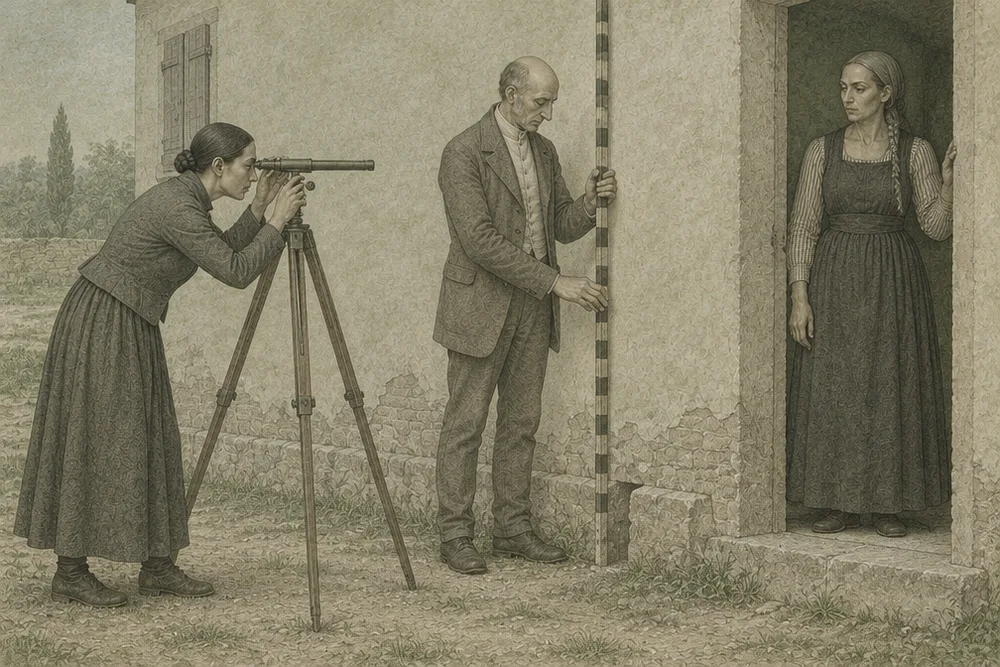
“A mason can judge that after the approval.”
Flavia lowered the telescope. A survey reference could survive its first place if its transfer was witnessed and recorded. She had learned that from the old level book, where a line had been carried from a vanished bridge to a new abutment. She wrote the intended transfer in the margin, careful to distinguish a future measure from a measure already made.
Agnese watched from the door. “You will move the stone, too?”
“If it can be removed intact.”
“And if it cannot?”
“Then we will tie the new mark to it before the masons touch it.”
“Good.” She turned back inside. Her approval, like her anger, was practical and spare.
Flavia packed the level in its case. The walls of the house were quiet in the light, but every measure made them more legible as an obstruction. The chamber would occupy the space where the laundry line had stood. The feeder would take the yard, and the front wall would be cut back to the foundation. The rear room might survive as timber and roof, but it would have no safe entrance, no water yard, and no protection during excavation.