The Road That Ended at Home
Page 152 of 276
Chapters
At a foot’s depth, the peat gave way to a brown, sandy layer. Flavia crouched at the edge and compared its height with the staff. The men widened the cut enough to let her see its face. She noted the change, the color, and the way the soil crumbled when touched. The next layer held together more firmly, with small flecks of grit. They set a plank against the side before going deeper, though no one climbed down. The ditch continued to run behind them. Its sound had become familiar, a low persistent rush under the scrape of spades.
The foreman’s blade struck something smooth. He stopped and called for Flavia. They brushed the face clean with a hand shovel. A band of pale gray clay appeared, thick and compact, with a sharp upper edge. It ran nearly level across the exposed soil, its surface pressed flat as if a broad hand had smoothed it. Flavia touched it with the tip of her pencil. The clay took no mark at first. When she pressed harder, the pencil left a shallow groove. A bead of water gathered on the blade where it had scraped the face, but the clay itself did not crumble.
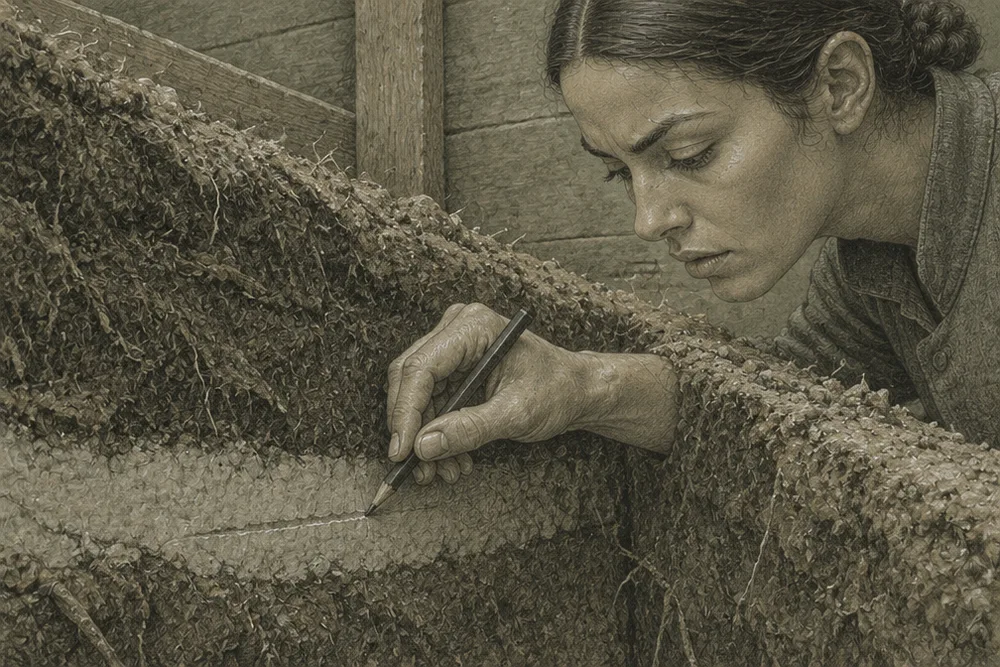
“There,” said Rina. She stood by the well, watching. “That is what I hit when I set the bean stakes.” She pointed to a patch farther along the garden. “It keeps the water from going down. My father used to say the bed was a lid.” “How deep?” Flavia asked. Rina showed with her hand, from the surface to just below her wrist. It was not enough to locate the whole layer, but it matched the top of the clay they had found. Flavia checked the level. The seam lay between the feeder and the well, continuous in the direction of the garden. The ditch could seep into the upper soil; the clay would keep that water from reaching the well below.
Flavia called for a second reading. The clerk held the staff while she sighted across the exposed band. Its upper edge ran almost level, dipping only slightly toward the lower garden. She set a measuring rod against the face and recorded the depth. The water moving through the feeder had no simple downward path here. The seam was not a crack or a patch; it was a continuous bed of clay, dense enough to hold water above it and isolate what lay beneath. The well drew from a lower pocket, fed by another course of the ground.