The Road That Ended at Home
Page 120 of 276
Chapters
At the edge of the road, she folded the field sheet along its old crease. “Tomorrow I take this to Vezzi.”
“Tomorrow,” Rina agreed. “Tonight you eat something.”
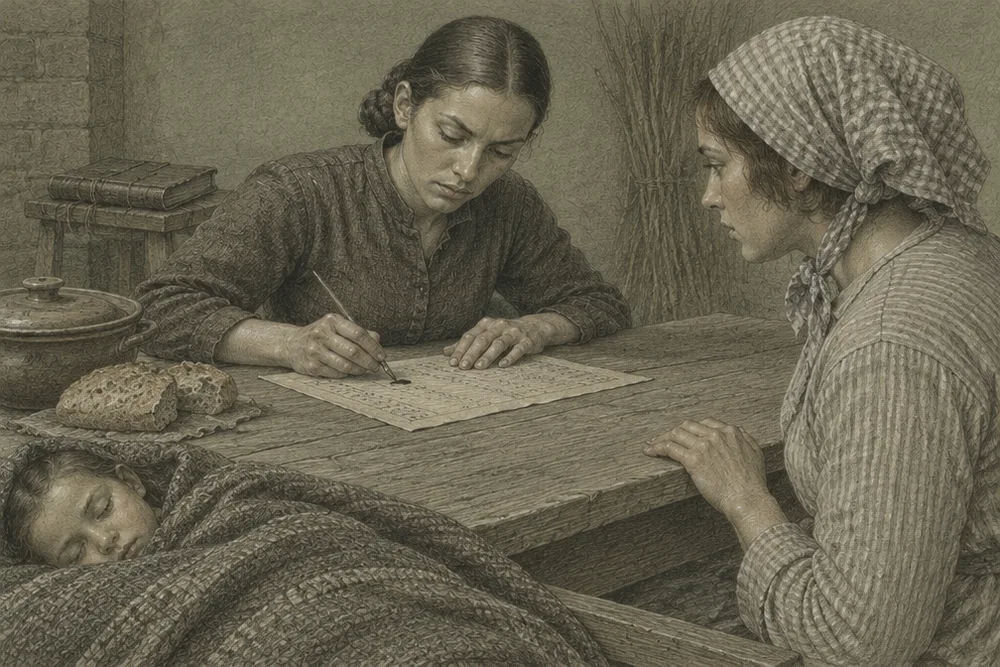
They ate at Rina’s table, where the bread was coarse and the soup had more water than beans. Rina’s husband was away with a cart; her youngest had fallen asleep on a bench under a shawl. Flavia set her wet field book on a stool, away from the bowl, and copied the measurements onto a dry sheet while Rina watched the child’s breath stir the wool.
“You will tell Vezzi the route costs more,” Rina said.
“Yes.”
“And he will ask if the direct line is still cheaper.”
“Yes.”
Rina lifted the pot lid, checked what remained, then set it down. “Then tell him the cheap line spends a house. A house is not a number you can leave out because it makes the sum better.”
Flavia thought of the clean survey Vezzi had once offered to pay for, the empty toll station printed where her family lived. She had corrected that drawing and lost the permanent post it might have earned. The wages she had now came by measured day; the instrument debt still followed her. Yet she knew what would happen if she brought an uncosted route to the office. The commissioners would see only a longer channel and ask why the shorter one had been abandoned.
“I will put the costs beside the alignment,” she said. “Every crossing. The lost rows. The grate. The turn. I will ask them to compare like with like.”
“And if they do not?”
“Then I will make them say what they are choosing.”
Rina gave her a look that was almost a smile, but tiredness held it back. “That is more than most people ask.”
Flavia finished copying the figures. She showed Rina the page, reading out each item so the grower’s compensation would not vanish into a general allowance. Rina corrected the number of onion furrows and reminded her to include the cart access before excavation. Flavia entered the correction in dark ink, pressing hard enough that the letters showed faintly on the page beneath.
Outside, the air had turned cold. The sound of the canal reached them faintly through the shut gate: water restrained on the other side, moving past without entering the lower fields. Flavia rolled the drawing around its wooden slat and tied it with string. The contour was not a solution yet. It was a route that did not demand an empty kitchen, and a price that could be argued over in daylight.