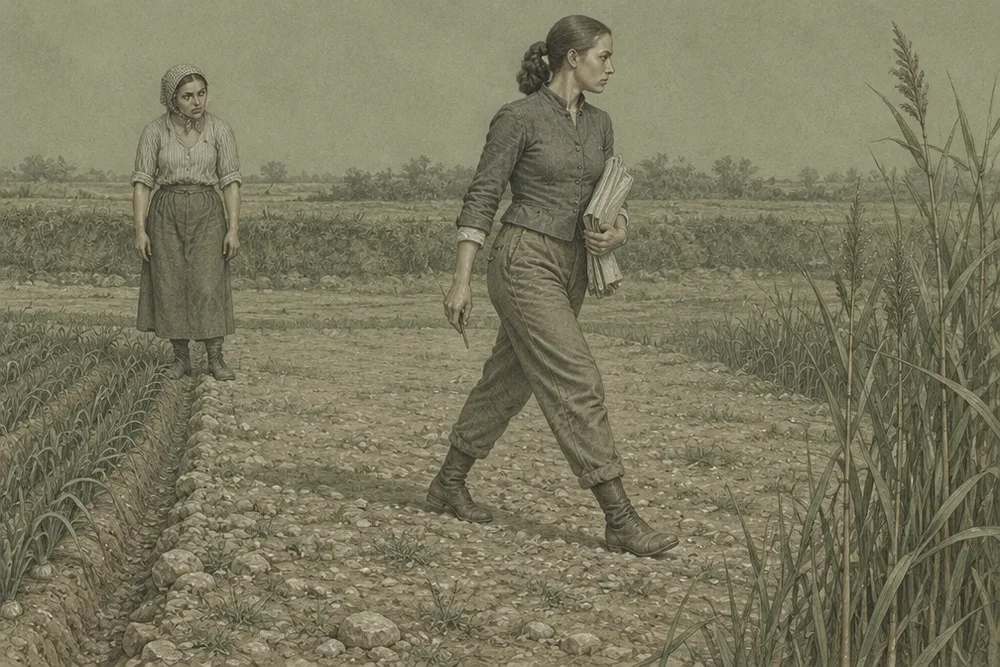
The Road That Ended at Home
Page 117 of 276
Chapters
“The channel can go through this part,” Rina said. “But the cart turns here. If you take the whole wedge, it cannot.”
Flavia paced it. Twelve feet at the widest, less than eight at the narrow end. She sighted along the proposed line and imagined a shallow bank, a footbridge, a cart swinging through the turn. There was not room for all three without shifting the channel or sacrificing a little of the onion row.
“How much of that row?”
“Four furrows, maybe five. If we dig after the first harvest, the bulbs will be out. The seed onions stay.” Rina looked across the field toward the embankment. “The grower will want payment before anyone puts a spade in.”
Flavia wrote the estimate in the margin, then added the crossing, the culvert grate, and the hand-laid stones needed to keep the channel from eating the lane. Her figures were rough; each was an obligation that would have to be carried back to the commission and made legible to people who preferred blank land and simple prices.
“There is another problem,” Rina said.
Flavia raised her eyes.
“The first leaseholder will agree if he thinks the water goes to his own plot. The second will agree if he thinks it goes past the first. The third will say neither of them can promise anything because the line reaches his boundary.”
“I can mark the limits.”
“A mark is not a promise.”
“No.” Flavia turned the pencil between her fingers. “It is a place to begin one.”
They returned to the lane by the route a cart would take, stopping at each narrow turn. Flavia tested the ground with the heel of her boot and recorded where a wheel would sink. In the margin she made a list of names to ask—not the landlords alone, but the tenants whose paths and beds would be crossed. The paper was growing crowded with people the original drawing had not needed to see.
Rina glanced at it. “You have a great many names now.”
“The route has a great many owners.”
“Users,” Rina corrected.
Flavia amended the word.
By late afternoon, they had found a line that held its fall from the east culvert to the wedge. It was not elegant. It turned twice where a straight channel would have run through the Bellori kitchen, and its banks had to be low enough to avoid blocking the garden paths. On the sheet, the new route looked like a patient hand had drawn around a bruise.