The Road That Ended at Home
Page 102 of 276
Chapters
“Time. Work. A line that leaves the house and yard alone.”
“That is three things.”
“It is.”
Her mother’s face stayed calm, but she pressed a thumb along a crease in the ledger. “We have survived on less than three.”
“I am not asking you to.”
“No,” Agnese said. “You are asking yourself to.” She shut the book without snapping it closed. “You have always thought that if you carry the whole weight alone, no one can say you made them carry it.”
Flavia looked at the table. A brown stain, old and round, marked the wood near the ledger’s corner. “If I put our name in the schedule, it may cost us the house.”
“The house is already on the line.” Agnese’s voice did not rise. “You did not make that true by writing it down.”
“The straight feeder would cross the yard.”
“Then find another way.”
“I’m going to.”
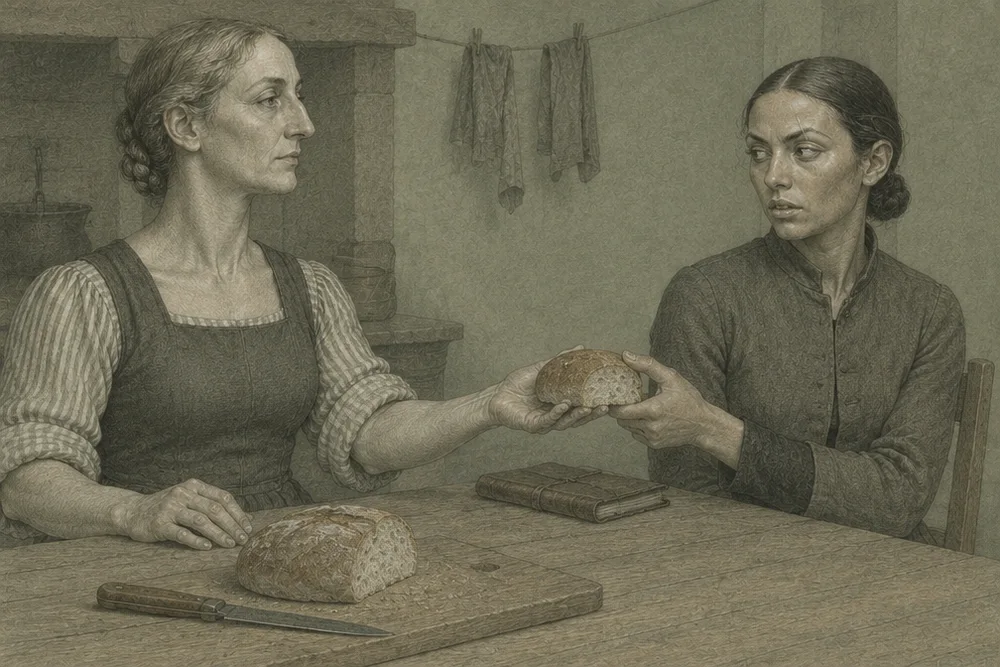
Agnese reached for the small loaf and cut it with the bread knife. She gave Flavia the larger heel without comment. “The rent is due at the end of the month,” she said. “I have two wash orders still to finish. Your wages are not our only measure.”
“I know.”
“Do you?”
Flavia took the bread. Her mother had kept the household accounts through years when the toll station’s official use dwindled to a name on paper. She knew the rent, the value of each wash order, the cost of fuel, and the number of days before the next payment. Flavia could calculate gradients more easily than she could admit how frightened she was of being unable to help.
“I know what is due,” she said. “I don’t know how long I can manage without regular wages.”
“That is different.” Agnese returned the knife to the board. “We can speak truthfully about both.”
The answer stung because it was fair. Flavia ate a bite of bread and found it less dry with stew. She told her mother about the canal levels, the copied foundation record, and the leases. Agnese listened, occasionally asking the location of a garden or the name of a tenant. She did not ask whether Vezzi had praised Flavia’s work. She had learned long ago that praise could not be spent.