The Last Dry Address
Page 248 of 257
Chapters
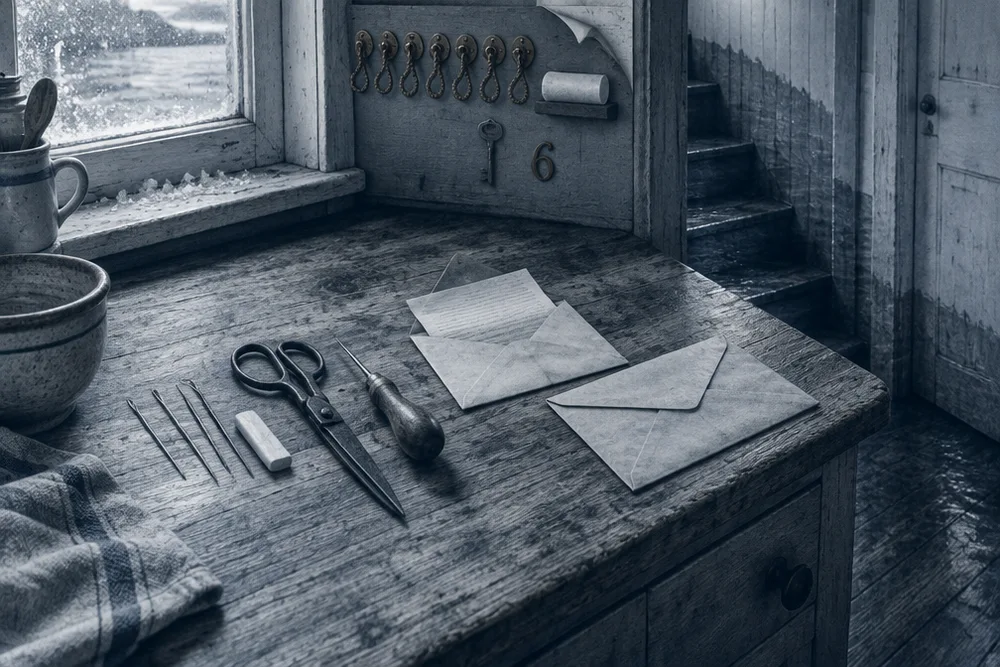
Tamsin set down her hand tools: needles, chalk, shears, a palm-sized awl. The space looked too small until she laid them out. Then it looked exactly as large as it was. She had no sign, no machine, and no reason to claim the kitchen belonged to her. She did have work already promised by two neighbors, and Mara had agreed to let her take it.
“I’ll keep the books separate,” Tamsin said. “Your kitchen charges here, my repairs there.”
“Good. Separate books are easier to read when people disagree.” Mara turned to a pot steaming on the stove. “And don’t mistake my letting you work for forgiveness.”
“I don’t.”
Mara glanced back at her. The press of her lips eased, but only a little. “Then we can get on with it.”
The seven weeks had left paper trails in every room the claims process touched. Some were public: the manifest, its wrong heading, the copied indexes, Idris’s audit admission. Others held names and sleeping places that people had not agreed to put on display. At the hearings, sealed attachments had been available to the parties and the board, but not read aloud to a roomful of strangers. Mara had fought for that distinction, and the successor board had adopted it.
Now she and Tamsin had made two envelopes for the kitchen’s own records. The larger one held public evidence and findings. The smaller, closed with a strip of paper across its flap, held intimate household details: the back-lane ledger extracts, private addresses, and accounts of who had slept where. Mara wrote on the front, ACCESS BY PERMISSION OF THE HOUSEHOLD.
“If they ask for the whole book again?” Tamsin said.
“They can ask. I can say no, or offer the lines that matter. The fact that a record exists doesn’t mean it belongs to every person who wants to use it.” Mara pressed the envelope shut with the flat of her hand.
Tamsin thought of the manifest’s curled corner and its neat rows. A line had once seemed to make the world simpler: a place on one side, a conclusion on the other. The board had found Oren’s residence by testing call slips against a paid workshop invoice and the evidence of a bed. His case did not need the host list to place him anywhere. Other households had proved their cases differently. A few had not proved them at all.
She wrote the date on the public envelope. “This way they can inspect what was used without turning every private detail into a new exhibit.”