The Last Dry Address
Chapter 9 · The Back-Lane Ledger
Page 103 of 257
Chapters
At nine, Mara Sedge was waiting in the Silt Room doorway with her canvas apron tied over her coat and her chained bifocals swinging against her chest. The claims annex had once stored rope; old hooks still ran along the wall above the audit boxes. The drawers were marked by postal walks, not by height above the water. Tamsin had learned that the distinction mattered, though not yet how much it could cost.
“Tell me mine is still safe,” Mara said. She stood compact and square in the doorway, feet turned out, round cheeks drawn tight. “Not the general answer. Mine.”
Tamsin glanced toward Idris Pell’s worktable. He was bent over a citation schedule, one hand resting on his flat brass key as if it could keep the papers from shifting. He had told them the manifest was a host list, not a list of dry homes. That had changed what the old document meant, but not what the county had done with it. Mara’s approved award was still waiting to be paid.
“I can’t tell you it’s safe,” Tamsin said. “Idris is checking which payments depend on the list.”
“That is not a comforting thing to say to someone who came here before breakfast.”
“I know.” She kept her chin tucked. “I won’t pretend I know more than I do.”
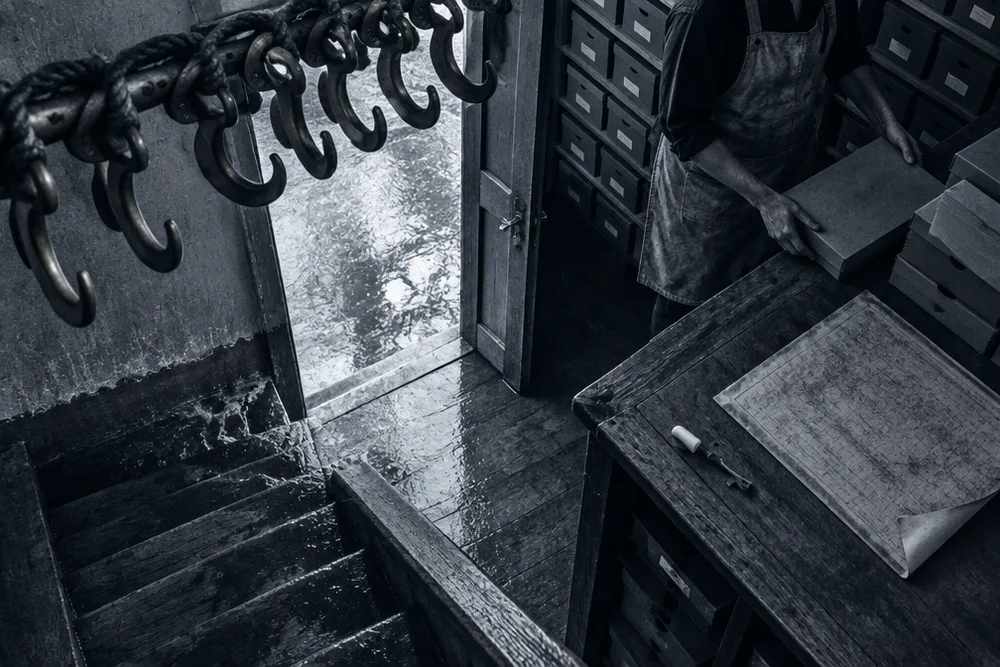
Mara’s gaze moved from Tamsin to the boxes beneath the rope hooks. “Then let’s find what we know.”
They went to Mara’s Long Kitchen by the back lane, where the street door and the lane door opened onto the same long room. Morning light came through the high panes in a flat wash. Tables had been pushed aside to make a clear path between the exits; a stack of folded chair cushions sat beneath the serving hatch.
Mara went straight to a cupboard at the kitchen end. She took down a tin with a dented lid, opened it, and removed a thick account book wrapped in a square of cloth. The binding had softened at the corners. She set it on the table but kept one palm over it.
“This is not the ferry list,” she said. “This is mine. Meals, coal, soap, beds when I had beds to spare. Sometimes a person paid. Sometimes I wrote it down because they said they would.”
“You kept it all this time?” Tamsin asked.
“I kept it because I expected somebody would eventually want to know who ate here. I did not expect them to treat the people in the book like parcels with labels.” Mara loosened her hand from the cover. “You can look at the pages you need. You don’t take the book away.”