The Last Dry Address
Chapter 17 · The Chair Across the Slot
Page 209 of 257
Chapters
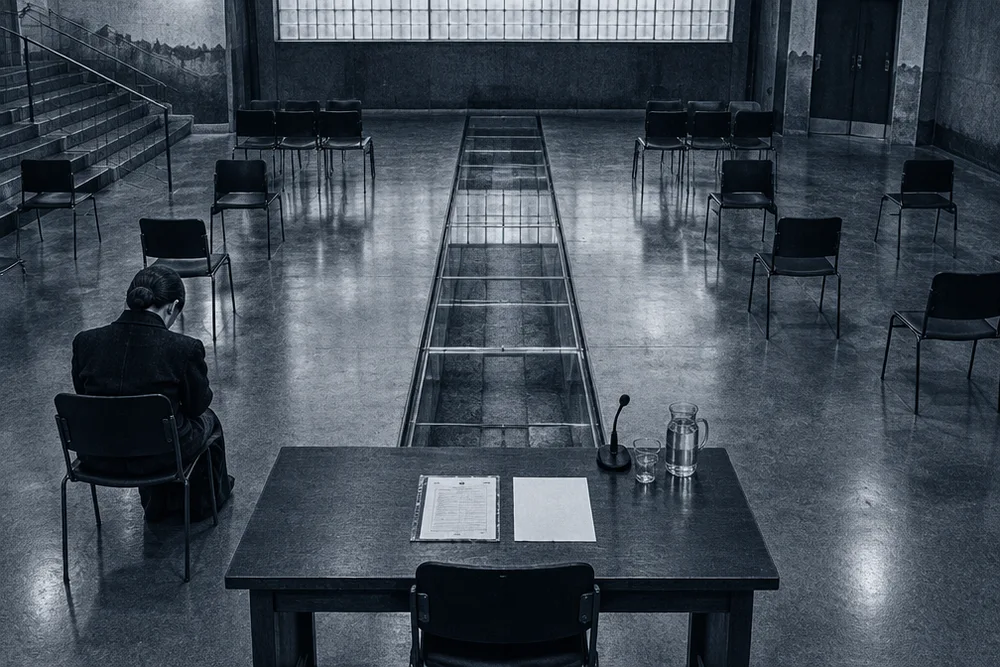
By the second week, Counterweight Hall smelled of wet wool, glass cleaner, and the dust shaken loose from the old ferry machinery. The successor board had hung a notice beside the entrance: Supporting records containing private household details could be sealed; parties to a claim could request access. Someone had underlined parties twice. Idris Pell read it each morning, though he had helped draft the procedure and knew the words by heart.
He carried the manifest in its clear sleeve and a blank sheet cut to the same dimensions. His stiff left knee objected to the stairs, so he paused at the landing and let the hearing room settle into view: chairs spaced with deliberate gaps, witnesses seated apart, the glass-capped floor slot running from the rear wall toward the table. Tamsin Leth sat at the claimant’s end, chin tucked. She had not yet been called. A few rows behind her, renters and award holders occupied separate clusters without quite forming them.
Idris set the blank sheet beside the original. He had brought no projector, no enlarged copy; he wanted the room to see the paper’s proportions before anyone saw his conclusions. The curled corner of the manifest lifted inside its sleeve. A board member, Halden, tapped the table once. “Mr Pell, explain what we’re looking at.”
“A ferry job record,” Idris said. “Not a survey. It was used as though it recorded properties that remained dry. Today I’m showing how its columns were made and used, not asking you to accept every entry as proof of a person’s residence.” His brass key rested against his cardigan as he leaned over the table. “The original is on the left. The blank is on the right.”
A man near the back murmured that a blank page could prove anything. Idris heard the impatience in it, and the tiredness underneath. “That’s true,” he said. “So I’ll tell you what the blank can’t prove, too.”
He took a pencil, not a pointer. The manifest’s columns were narrow enough that a name, a location, and a number crowded against one another. On the blank he pencilled the headings as he understood them: stop, beds available, count, remarks. “During a shift, the person at the depot could mark a place where people might be put up. The count wasn’t necessarily passengers on one sailing. It might be beds offered, or a change in capacity.”
“Might?” asked a woman at the aisle. “That’s a useful word when you’re trying to turn a wrong record into a harmless one.” She had a folded paper in her lap and kept both hands on it. Idris recognized her from a claim whose relocation notice had arrived at a neighbor’s address. “It is not harmless,” he said. “The board should not treat it as one.”