The Linen Ledgers of Marrow Quay
Page 86 of 183
Chapters
Ada asked what counted as ordinary. Sabine looked at the two parallel lines of needle holes, the ruled page in the daybook, the few words visible on the linen. “It depends on what the claim is. A bill proves a bill. A neighbor can speak to who used a room, but only if they agree to be heard. We need two things that answer different questions.”
“And if a witness refuses?” asked Mr. Tern.
“Then we cannot force the answer out of them.”
She had expected the words to make her feel powerless. Instead they settled in her mind like a tool laid within reach. The crew had refused to lend the sails to a public display; they had agreed to this small test because the process kept the difference between what could be seen and what could be claimed. Sabine was beginning to understand that the difference was the point.
Ada placed the three findings side by side: dated address, confirmed delivery, and no proof of ordinary domestic life. She did not write a name. Sabine looked at the empty space where one might have gone and felt, unexpectedly, that it was not a blank to fill. It was a boundary the rule had to respect.
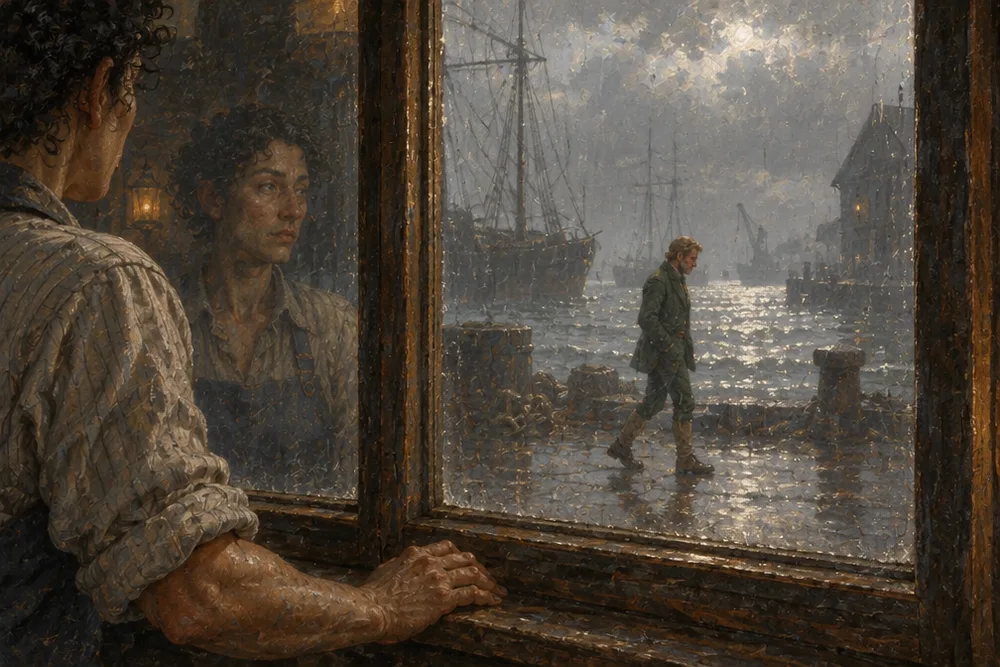
The meeting paused while Ada went to speak with the harbor clerk. Mr. Tern remained at the table, and Ivo carried the sail into the corridor rather than leave it unattended. Sabine stood at the window. Below, the tide was coming in around the piles; a coil of rope bobbed against a post and turned slowly in the water.
Through the glass she saw Gideon Flett cross the yard in his bottle-green suit, gaiters splashed with quay mud. He had been told the pilot would not decide any individual claim, but company men had a way of treating a closed door as an invitation to imagine what was behind it. He glanced toward the hall, then continued up the road without coming in.
Sabine returned to the table. The first slip could corroborate a dated address, but not a home. The second traced a forwarding route, not a place of residence. The third had neither a living witness nor a separate record to strengthen it. The daybook was useful, though. It could test the date without repeating the private entry. It had made the linen more credible and less complete at the same time.
“That is what we needed to learn,” Ivo said from the doorway.
“I wanted it to be enough,” Sabine replied.