The Linen Ledgers of Marrow Quay
Chapter 14 · Blank Linen Demonstration
Page 131 of 183
Chapters
By Sunday morning the harbor hall smelled of wet wool, lamp oil, and the salt people carried in on their boots. Nella Saye sat angled toward the committee-room door, as she always did in a room where strangers might decide that a question was harmless. Her brown reefer was buttoned to the throat; the ochre scarf at her neck hid the pale line where wind had split her skin on the inland road. Beyond the gallery rail, the public benches filled with cottage tenants, quay hands, and people who had come merely to hear whether a house could be lost by noon. They had been promised a hearing on the test, not a display of the records. Nella had insisted that the distinction be spoken aloud before anyone sat down. At the front table Ada Rusk arranged three sheets of paper and a shallow wooden tray. The sheets showed only the proposed rule, its lines broad and its wording plain. The tray held a square of linen with no writing on it. Sabine Otterwick stood beside the wall, her hands folded over the indigo apron she wore even in the hall. She watched the faces rather than the table. Nella recognized the caution in that: a room could be more dangerous than a gale when everyone believed they had come for justice. Gideon Flett had taken a place near the aisle, bottle-green suit immaculate despite the damp. He rocked once on his toes, then stilled when Ada called the hearing to order. He spoke first, not because the room had agreed he should, but because the company’s buyer had sent a representative and the representative had demanded precedence. His name was Vale; Nella had not met him before. He held his hat against his stomach and examined the audience as if counting chairs that might need to be removed. “The company is not asking for a scandal,” he said. “It is asking for a schedule that can be relied upon. If old household entries are allowed to decide present claims, then we must know whose entries they are. We must know the names behind discontinued households.” He said discontinued as if people were machinery, stopped and put aside. “Otherwise a hidden roll might be used to multiply claims, or to conceal an interest the buyer ought to know.” Nella looked at the blank linen. For years she had wished that a name could be wiped clean as easily as chalk from a slate. It could not. But a person might still choose what the name was permitted to do.
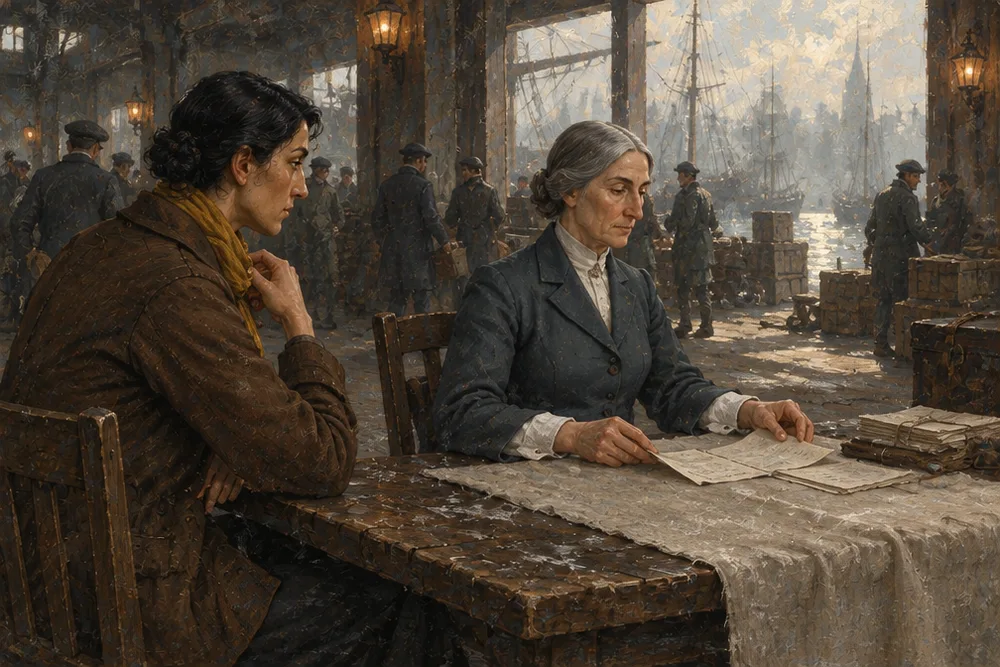
A public hall with benches, Ada’s papers, a blank linen square, and Nella turned toward the door.