The Linen Ledgers of Marrow Quay
Chapter 3 · Slip in the Salt Hem
Page 26 of 183
Chapters
On Tuesday morning the tide had left a fringe of bladderwrack along the quay steps, and the sail loft smelled of wet hemp, old smoke, and the tea Mara had sent up in a stoppered bottle. Sabine braced her hip against the cutting bench and held the torn mainsail flat with both forearms. It had come off the ketch Larkspur after a rough passage, and its owner wanted the patch finished before the next tide carried him out again.
“If I mend it as it is, that seam will split beside the patch,” she said. The sail lay in ridges across the trestles, a pale, salt-stiff country. Its old repairs were of different ages and hands: stout brown thread, a finer blue, a row of tiny white stitches nearly worn away. Sabine had been told to remove only what was necessary. She eased the knife beneath the ragged edge, taking care not to cut the sound cloth.
The first thread gave with a dry little snap. The second held. She leaned closer, working the point between two layers, and the folded end of something linen-colored slipped from the hem and caught on her knuckle. It was no larger than a postage stamp, doubled inward and sewn beneath the binding. A tide of dust rose when she opened it. Under the dust were two lines of brown writing, cramped and blurred at the folds.
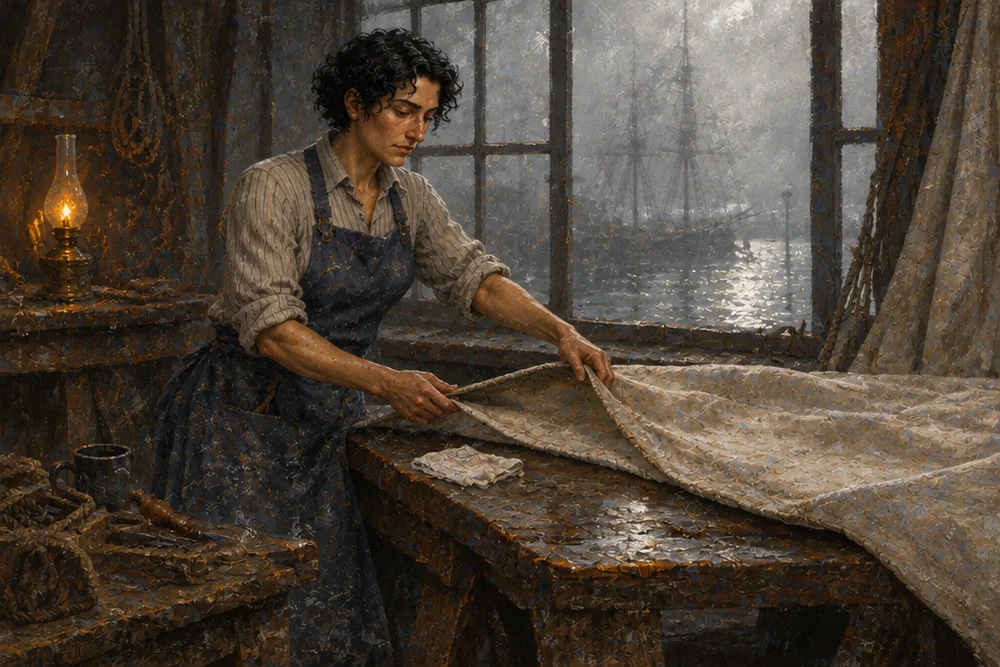
She stopped with the needle in her hand. There was a date, then a place name she could not make out, then a second date in a different ink. The paper-thin linen was marked not with a sailor’s log but with neat, abbreviated words. The hem had been stitched over it so carefully that the cloth itself seemed to have grown around the scrap. Sabine set it down on the bench as if it might take offence at being handled.
From the quay below came the clatter of a cart and a man calling for a line. The sail’s owner was not there to be asked. Sabine glanced at the door, then at the torn seam. The company’s notice, folded in the pocket of her apron, seemed to press its square edge against her ribs. Seven days to prove a permanent household; a claim form with no place for her name. And here, within reach, something that might prove where people had lived.