The Linen Ledgers of Marrow Quay
Chapter 7 · Two Envelopes of Coins
Page 65 of 183
Chapters
Mara counted the coins twice, then laid them in two rows on the washhouse table: one row for the cottage deposit, one for the washhouse bid. The first row was too short by a sovereign and a half. The second was shorter still. Between them sat the rent book, its blue ruled pages warped by steam, and a saucer with a ring of lye dried white around its rim.
Outside, the yard was slick with the morning’s rinsing. Sheets snapped on the lines where the wind could find them; the rest hung heavy as sails. Mara stood with her heels apart, copper braid tucked beneath her kerchief, and watched a droplet gather at the hem of a pillowcase. She had earned every coin in those rows by boiling, scrubbing, wringing, and carrying. She had not earned enough to buy the place where she did it.
The washhouse had its own line on Gideon Flett’s sale schedule. It was not part of the cottages, he had explained, tapping the paper with a neat fingernail. A separate parcel, a separate price, a separate bid. His bottle-green suit had looked absurd among the steaming tubs, but his arithmetic had not. The buyer could take the washhouse, and Mara’s work with it, unless someone made an offer by Sunday.
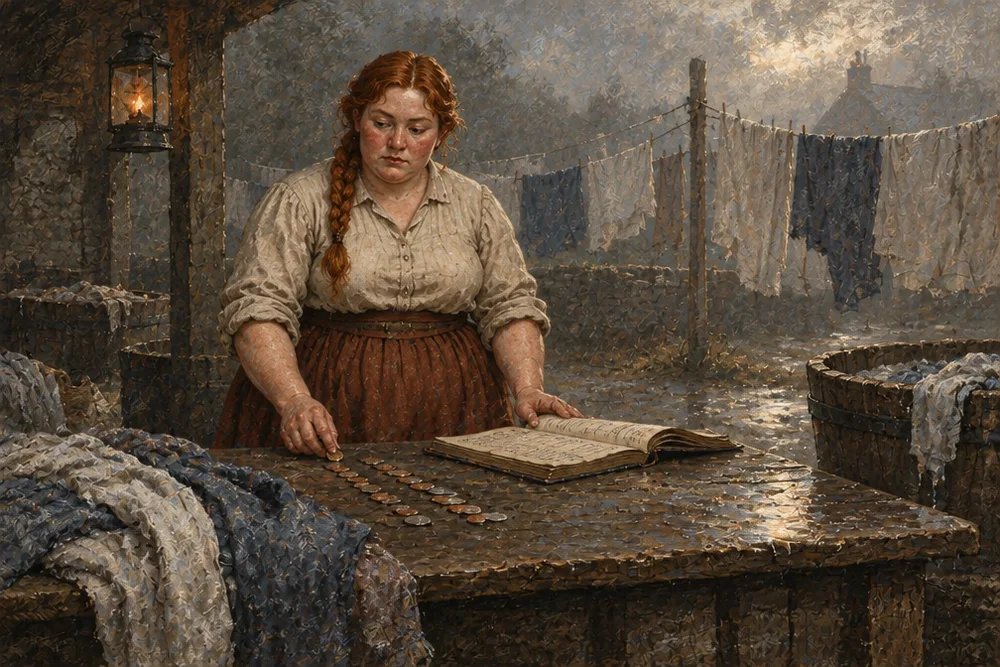
Her sister’s cottage stood uphill, one of eight, and Sabine’s right to it was still being tested. Mara had wanted a claim in her own name, not a favor tucked under Sabine’s. They had talked about it after the first notice, and Sabine had said, with the stubborn quiet she used at the loft, that she would not ask Mara to spend her savings on a house that might not be theirs. Now that was exactly what the sums demanded.
A knock sounded against the open door. Mrs. Prawl, whose laundry came every Tuesday, entered carrying a basket of shirts and a folded newspaper. “They tell me you mean to buy this place,” she said. Her gaze moved from Mara’s face to the two rows of money. “If you do, I’ll put down something toward it.” Mara reached for the basket, feeling its damp weight settle against her hip. “How much?” she asked. Mrs. Prawl named a figure that was small, but not imaginary.