The Linen Ledgers of Marrow Quay
Page 62 of 183
Chapters
“And now?”
“Now they may send us out anyway.”
Edith returned the sheet. “You’ve left the important thing for me to sign.”
“That I worked under your name?”
“That the company placed you there.”
“It did.”
“Then we write it together.”
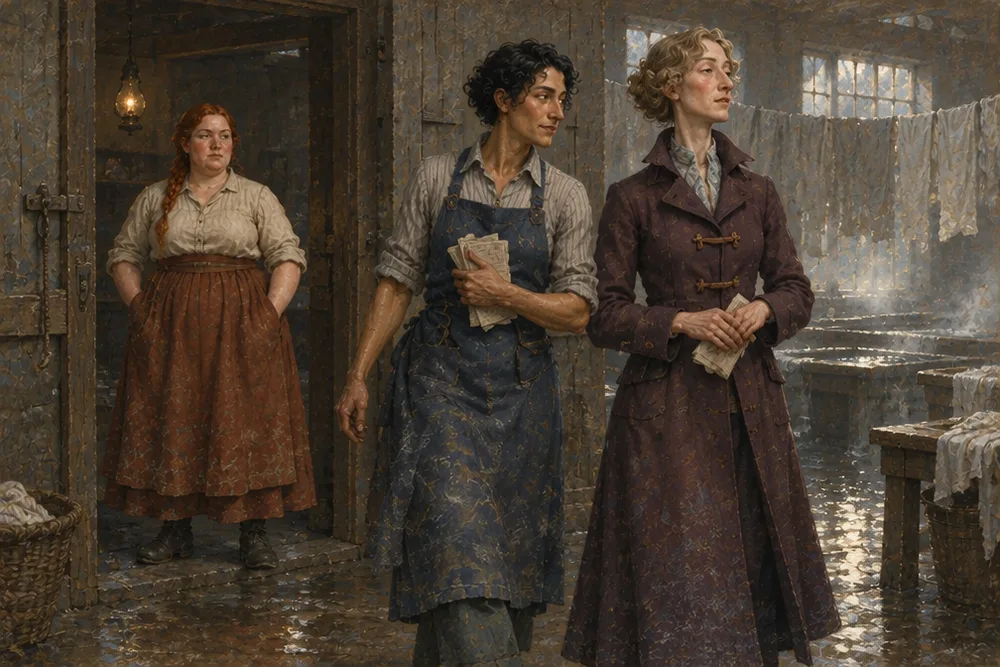
They walked back to the harbor office. On the way they passed the washhouse, where a line of sheets snapped in the salt air. Mara was inside, sleeves rolled to the elbow, sorting damp linen into baskets. She noticed them and came to the doorway, her heels planted apart.
“Did Flett accept your claim?” she asked.
“He hasn’t seen it yet,” Sabine said.
Mara looked at Edith. “He wants you to sign the house to yourself.”
“He wanted me to swear I live there.”
“And you refused?”
“Yes.”
“Thank you.” Mara said it without warmth or ceremony. Then she turned back to the washhouse, where a customer was calling for a parcel.
At the office, Flett read the two accounts in silence. His finger moved down the dates, pausing where they overlapped. “You have signed this, Miss Venn?”
“Not yet.” Edith took out the pencil she had sharpened the night before. “I’ll sign it if the wording is clear. I do not occupy Cottage Six. Sabine did the work. The company recorded her work under my name.”
Flett looked toward Sabine. “And you will sign the same?”
“Yes.”
“You understand that this may be treated as evidence of a breach of contract.”
“I understand.”
“The sale rule concerns residence, not employment,” Edith said. “You cannot use my signature to make the housing question vanish.”
His mouth tightened. “I make no promise about what follows.”
“Neither do I.”
Flett drew a blank sheet toward him and copied the two accounts into a single chronology. He was careful with his handwriting, leaving a margin wide enough for notes. Edith watched him change “occupied” to “states that she occupied,” then looked up when he reached the line about the wage roll.
“That wording makes it sound disputed,” Sabine said.
“It is disputed.”
“The work is not.”
“The record is.” Flett pressed the pencil point to the paper. “If I write that you performed it, I must note that the company has no signed hiring agreement with you.”
“Then note it.”
“The company may seek repayment or damages.”
“Then it may.”
Edith’s hands were cold. She tucked them beneath her elbows, though her coat was still buttoned. She had spent years wanting the company to admit its own part in her record. Now the admission threatened to cost Sabine her wage and perhaps her home. It was a bitter thing to discover that accuracy did not arrive as a clean correction. It came with a bill attached.