The Linen Ledgers of Marrow Quay
Page 56 of 183
Chapters
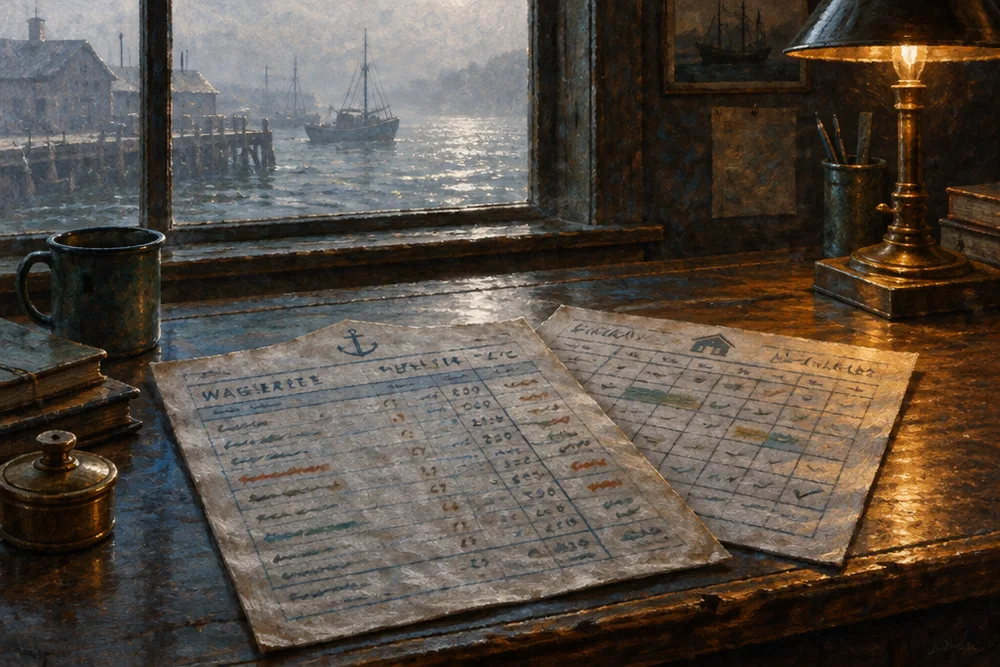
Flett slid two sheets across the desk. One was a wage abstract, ruled in red and black; the other was a copy of the company’s household schedule. The abstract listed Edith Venn as employed continuously from 1904 to the present. The schedule placed her at Cottage Six, with rent deducted from her pay. In the margin someone had written a small question mark beside the years 1909 through 1912.
“You see the difficulty,” Flett said. “If your service is continuous, the pension office will ask why you have not been at your station. If it is not continuous, they will ask why contributions were withheld during your absence. We must reconcile the dates before the transfer.” He tapped the red lines with a pencil. “There is also the question of the residence claim.”
“There is no question of my residence,” Edith said. “I left in 1909.”
“The company’s books say otherwise.”
“Then the company’s books are wrong.”
Flett rocked forward, then back. Edith had seen the same motion in men who wanted to appear patient while measuring the cost of patience. “The name on the wage record is yours. The rent is taken from your wages. The property roll identifies you as the household.”
“The name is mine. The wages were not.”
He looked up. “You admit that?”
“I have never denied it.”
“There are consequences.” He folded his hands. “For the pension record, certainly. And if you knowingly allowed another person to draw wages under your name—”
“I did not allow it for three years,” Edith said. “I left. Sabine took the place after I was gone. I understand now that I should have insisted on the correction at once. I did not know it would be used to make her invisible and me responsible.”
Flett’s expression changed only at the word responsible. He reached for the household schedule and squared it with the edge of the desk. “The sale is not a forum for every grievance against the payroll department.”
“You called me here because the sale needs a clean roll.”
“That is correct.”
“Then a clean roll requires the truth.” Edith’s voice had remained even, but her fingers were clenched inside her gloves. She set them on the desk. “Show me the form you want me to sign.”
Flett brought out a printed declaration. It asked Edith to confirm that she was the permanent occupant of Cottage Six and that the household particulars on the schedule were accurate. The lines for signature and date had been left blank. Below them, in smaller type, a statement warned that a false declaration could void a purchase preference.