The Linen Ledgers of Marrow Quay
Page 174 of 183
Chapters
Ada’s mouth tightened—not a smile, exactly, but a sign that she had heard the useful part. She asked the clerk to bring the public survey copy and the minutes from the boundary inspection. Those records showed the drain had been maintained jointly before the sale. The buyer’s representative argued that maintenance did not convey title. Ada agreed. Then she pointed to the deed schedule, which assigned the passage as a common easement for the seven qualifying cottages, excluding the vacant parcel’s rear strip.
“The easement describes access and maintenance,” Ada said. “The drain itself follows the boundary as surveyed. The buyer’s objection would put a common channel inside a parcel he did not purchase as part of the seven-house transfer. That is not what the schedule says.”
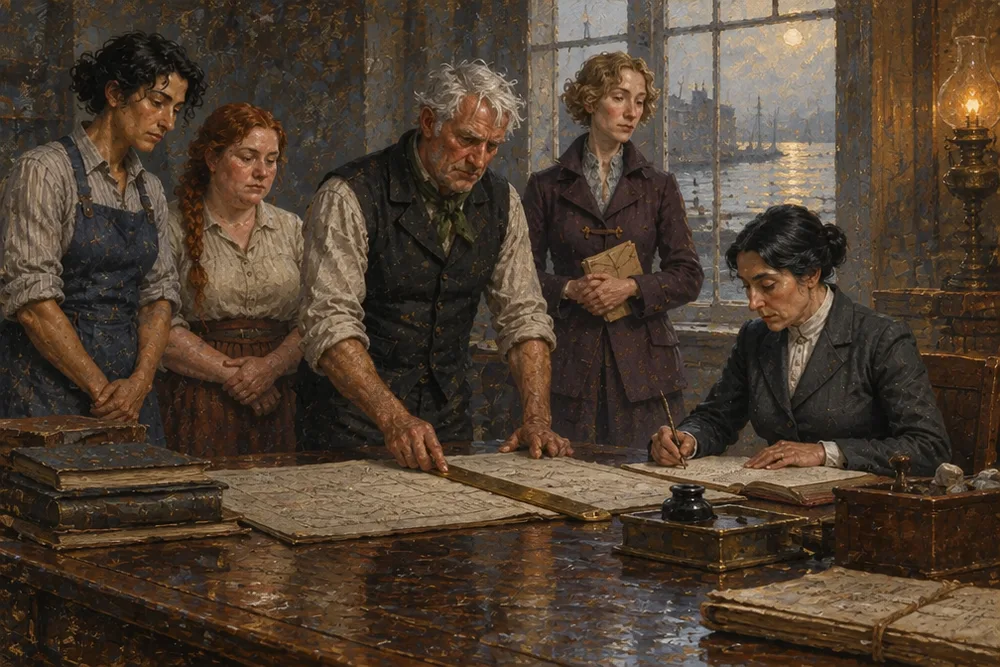
The representative bent over the plan. He produced a ruler from his case and set its brass edge against the drawn line. His cuff brushed the ink, and he drew back sharply, although it had already dried. He checked the distance between two marks, then looked up as if hoping the figures might have altered while he measured them.
“The buyer reserves his objection.”
“It is noted,” Ada said. “And answered.”
The clerk wrote both statements in the margin. No one asked for a name from a sail hem.
The representative asked whether the committee would reopen the question if the buyer produced another survey. Ada told him he could submit it before the window closed, but that the schedule would not be changed without a material error. He said he considered the matter a material error. She asked him to point to one. He pointed again to the drain. The clerk noted that, too.
Sabine watched the exchange without looking for an opening to plead. The measurements had been made by two men who disagreed about the result and agreed about the figures. The easement had been read aloud at the sale and copied into the deed. The public fact was enough. Ada did not turn to Sabine for confirmation, and Sabine was grateful not to be required to supply it.
The committee room door stood open to the public gallery. Behind its rail, villagers shifted on the benches, and the old boards creaked under their boots. A year ago the hall had filled with people wanting to know what the stitched slips said. Now most watched the clerk’s pen, the map, and Ada’s steady face. They had learned the difference between evidence and possession of it.