The Linen Ledgers of Marrow Quay
Page 11 of 183
Chapters
At closing, Sabine wrapped the claim form in a scrap of sailcloth and tucked it into the inner pocket of her apron. She had not filled in a single line. The act of leaving the paper blank felt almost like a refusal, though she knew the company would not mistake silence for an argument.
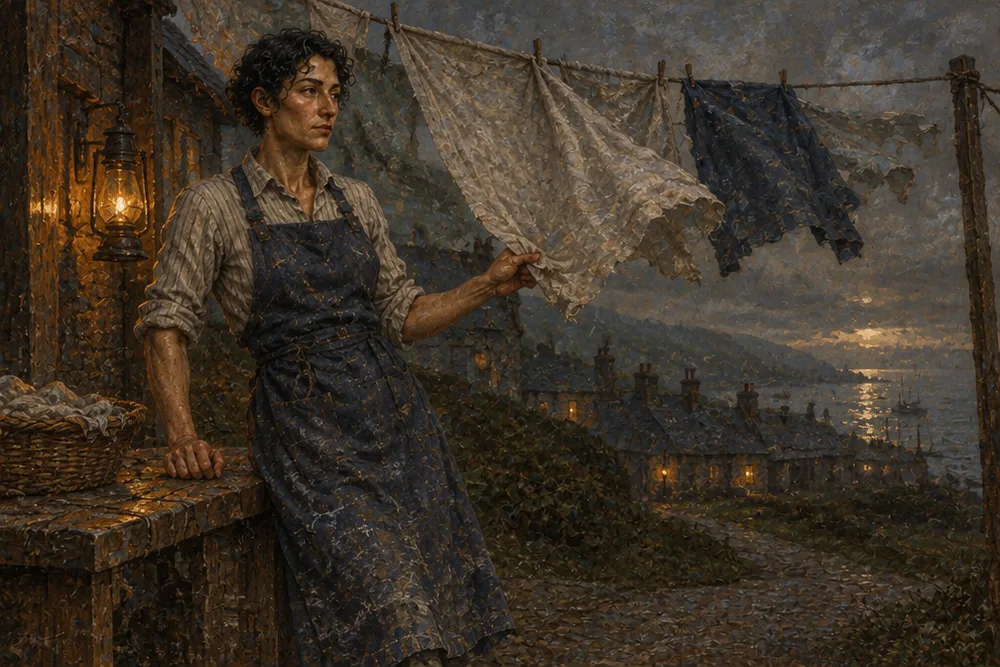
She found Mara in the yard, lifting a basket of washed shirts from the line. The fog had risen, and a cool wind moved the cloth in little waves. Mara’s face was flushed from the washhouse heat. Her arms were full, but she did not put the basket down when Sabine approached.
“I spoke to Ada,” Sabine said. “The charter may allow the schedule to distinguish residents from the company’s account names. She won’t promise anything.”
“Did you ask her to sign?”
“No.”
“Good.” Mara shifted the basket to her hip. “We don’t need a favor. We need a rule that applies to us without making Edith lie.”
“She may have to give a chronology.”
“Then she can decide.” Mara started toward the washhouse. “And you can decide what you’ll tell her when she answers.”
The door swung shut behind her. Sabine stayed in the yard, listening to the washhouse pump thud and the soft flap of linen overhead. The cottages stood darkening on the slope. Behind their windows were lamps, meals, small quarrels, wet boots, and people who would soon have to say which of those things counted as a home.
Sunday at six was not far away. The company had given the village one week, and the first day had already gone. Sabine had an unsent answer to the company, a letter on its way to Edith, and a household whose truth was clearer in the rooms than in any book. The form remained folded against her side, stiff and empty.
She went inside number six and lit the lamp. On the table she laid out the rent entries, the claim form, and a clean sheet for a second letter in case the first was lost. Then she sat with her hands flat on the wood. The house did not make a sound except for the clock and the faint settling of the stove. She could not yet prove that it was hers to claim. But before Sunday at six, she would have to find a way to make the truth legible without letting the company decide who had lived there.