The Bell That Cost a Ferry Landing
Page 234 of 284
Chapters
He measured from the sill to the first joint, then from the joint to the crown’s shadow. The right abutment was built of squared blocks laid in courses, each face darkened by years of water. The left had been patched with rougher stone, but its lower courses remained tight. He pressed the rounded end of his rule against the mortar. The joint yielded at the surface, no more than a skin’s depth; below that, the point struck hard grit.
“How far under the bank?” he asked.
“The old channel turns toward the ditch,” Rosamund said. “Nell says it was cut before her mother’s time. We followed the water as far as the grille.”
“That is not an answer to how far under the bank.” He looked up at her. “Did you see any movement in the arch when the water passed?”
“No.”
“Did you put weight upon it?”
“No.” Her chipped left incisor showed when she set her jaw. “The planks were over the mouth. I took them up one by one. I did not stand on the stones.”
Kit shifted his feet in the mud, knees flexed. “The bearing was on the bank side. It had gone down before we pulled the last board.”
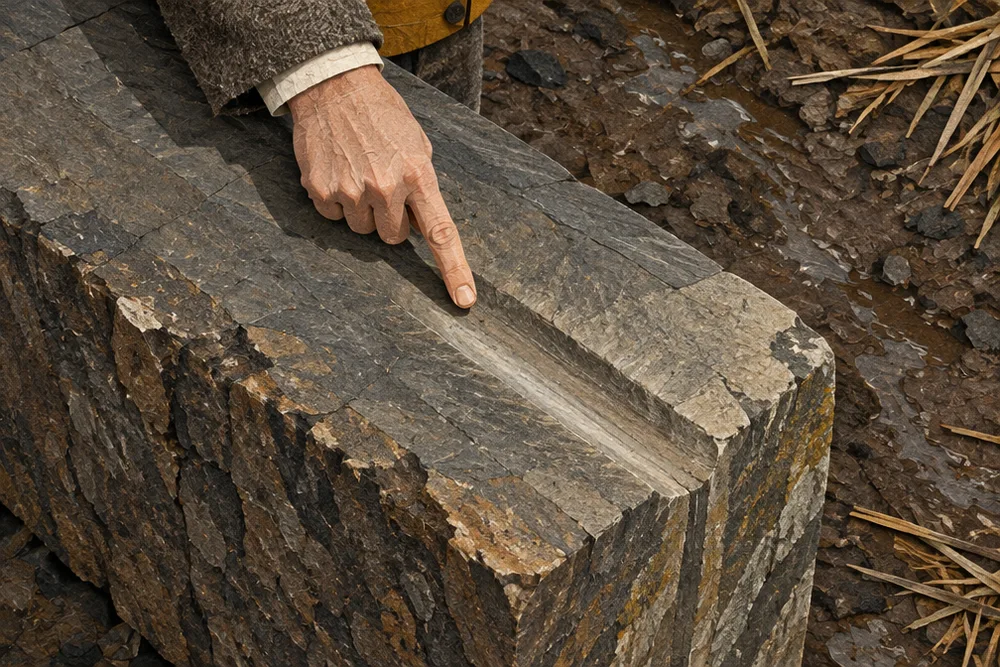
Peregrine measured the mouth’s width and height, then marked the dimensions in his pocket book. He asked Kit to show him where the bearing had rested. The young man pointed to a shallow groove in a squared block, worn smooth by timber. It did not look newly fractured. The bearing had sat there for years, and the landing’s weight had spread across it. Peregrine wrote this down, then stopped before the words could become a conclusion.
Varneck came nearer, but kept to the firmest gravel. “You can see enough to tell whether it must be shut.”
“I can see enough to tell that shutting it without a replacement would flood the cottages again.” Peregrine said it evenly, yet felt each word bind him more firmly to the exposed stones. “That is established by the trial. The question is what it will cost to make the passage safe.”
“And whether it is necessary to make it safe.”
Peregrine ran a finger along the lowest joint. It was firm where it mattered, though the mortar had washed out in a narrow strip. The sill stones were level, not sagged. He could not inspect the top from below, and the clay packed above the arch hid the very place most likely to fail. He would need the water lower and the bank shored before anyone could clear it. For now, he could judge only what the opening offered: two abutments still carrying load, and a crown that would not answer without being uncovered.