The Bell That Cost a Ferry Landing
Chapter 9 · The Upper Fields
Page 81 of 284
Chapters
Peregrine Cleeve’s drawing showed the embankment as a clean stroke of ink, the river on one side and reclaimed ground on the other. It showed no ditch, no cottages, no bell buried beneath a landing. The line was neat enough to please a board, and for three days he had been trying to make it true.
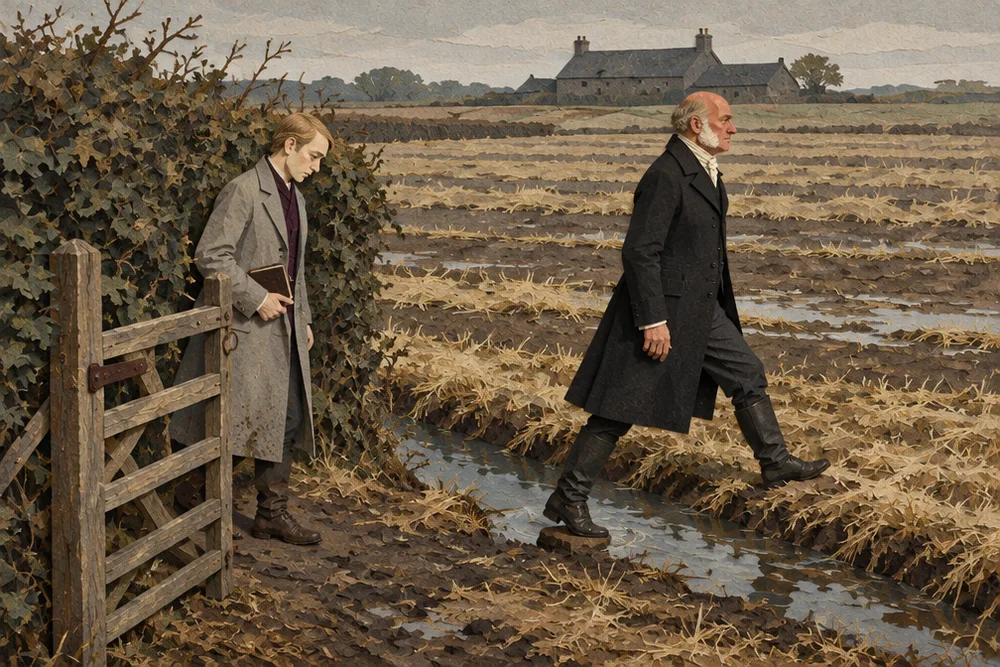
Edmund Varneck waited beside the gate at the upper fields, his black broadcloth buttoned against the damp. Beyond him, the land lay in a succession of shallow brown squares. The furrows were there; the winter crop was not. What remained of it made a thin, pale stubble, bent flat in places as though a hand had passed over the field.
“You have seen the figures,” Varneck said. His ivory neckcloth sat close under his thick chin. “You should see what they mean.”
Peregrine closed his notebook and followed him through the gate. He kept his elbows close, careful not to brush the wet hedge. His dove frock coat was already freckled with mud at the hem. On the far side, Varneck stepped over a narrow runnel and turned toward a farmhouse roof, dark with rain.
“The seed drowned before it took,” Varneck said. “They sowed twice.”
Peregrine looked at the ground. It was too soft under the surface, even where the furrows stood. His boot sank a little, then released with a sucking sound. “The embankment was not complete when the water came up.”
“Nor will it be complete if every measure waits for a perfect drawing.” Varneck’s small hands folded behind his back. “The commissioners paid for a bank to keep the river out. We cannot leave a gap because someone says a ditch might be on the other side.”
The word someone settled between them. Peregrine knew whom Varneck meant. Rosamund Trennick had spoken of a sound beneath her landing, and he had called it a buried remnant. He had not called it impossible. That distinction had become harder to preserve since the ditch below Fenwick Reach had run backward as the tide fell.
They crossed the next field by a narrow ridge left between flooded furrows. Varneck walked without hurry, his rigid back never bending to the ground. Peregrine watched his boots find the drier places. The landowner knew each rise by habit; the surveyor had only a chain length and a level to trust.
At the end of the ridge a farmer stood beside a handcart, its wheel sunk to the axle. He was a spare man in a patched coat, with mud dried up one sleeve. Two sacks lay under a tarpaulin. A third had split, and grains of seed clung darkly to the wheel spokes.