The Bell That Cost a Ferry Landing
Chapter 5 · Gravel Terms
Page 42 of 284
Chapters
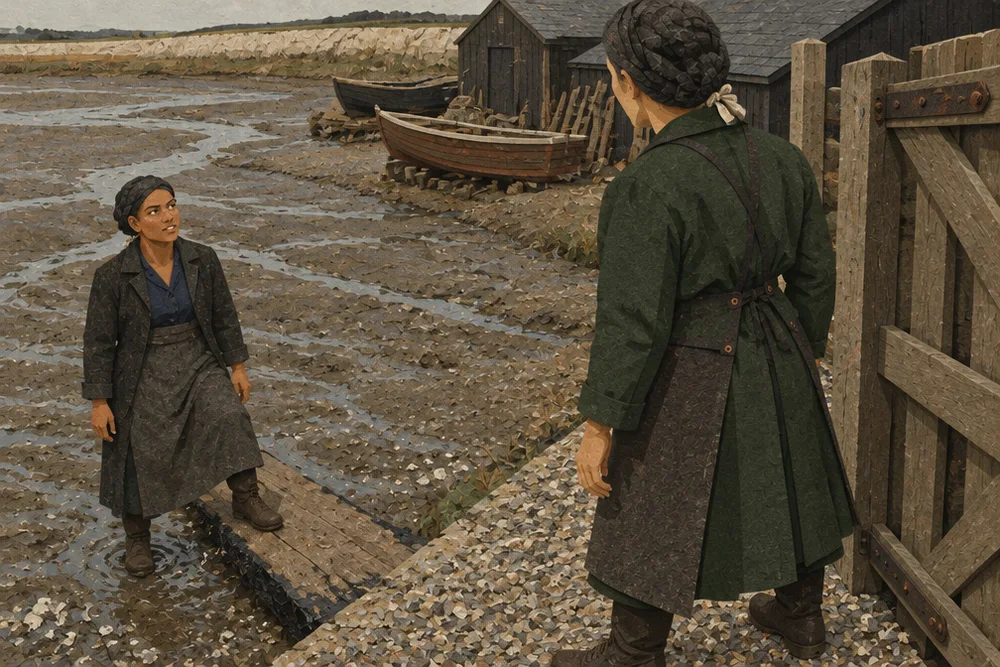
The tide had turned before Rosamund finished counting the nails in her landing. She stood with one boot on the last broad plank and one on the muddy bank, tallying what she could still afford to lose: six oak boards, a length of chain, the iron ring bolted to the post. Beyond them the new embankment ran east in a clean, pale curve, cutting the reach off from the low fields. Her landing was the only thing she owned outright, and even that had been bought with money borrowed against the boat and the small house where she slept.
A ferry could not live on a landing alone. The commissioners had made that plain when they announced the lease: a bidder must prove a dependable berth, safe in ordinary weather and usable when the new bank was closed. Rosamund’s landing answered the first part. It sat at Fenwick Reach below the old road, where the river narrowed between reed beds and the market road across the water climbed toward the coaching inn. But it rested on ground she had not yet persuaded anyone to trust. The surveyor’s drawing showed the bank as solid. His pencil had made a straight, certain line through her future.
Rosamund leaned from her ankles to look beneath the planks. The river had retreated enough to show the muddy foot of the landing, scored by tide-runnels and stippled with shells. At the far end, Blythe Allingham’s yard stood on a tongue of gravel above the waterline. Its sheds and boats looked secure even in the wet dusk. Blythe herself was at the yard gate, broad feet planted apart, bottle-green coat open over a leather apron. She was watching Rosamund count the nails.
‘You’ve measured it three times,’ Blythe called. ‘The boards haven’t grown.’
‘No. But the cost may have.’ Rosamund straightened. A chipped place in her left incisor caught her lip as she spoke. ‘The commissioners want a fallback landing. Yours is the only one above the soft ground.’
Blythe rubbed a thumb along the edge of her apron. ‘If you use my yard, you pay for the privilege. A landing fee per trip. No favors for an old acquaintance.’
They were not old acquaintances. They had spent years competing for the same passengers, and Blythe had a better berth, a better boatyard, and a name that carried farther up the reach. Rosamund had her mother’s route and the stubborn belief that she could win a lease before the commissioners finished closing the river’s old ways.
‘Name the rate,’ Rosamund said.