The Bell That Cost a Ferry Landing
Chapter 25 · Iron in Place of Bronze
Page 253 of 284
Chapters
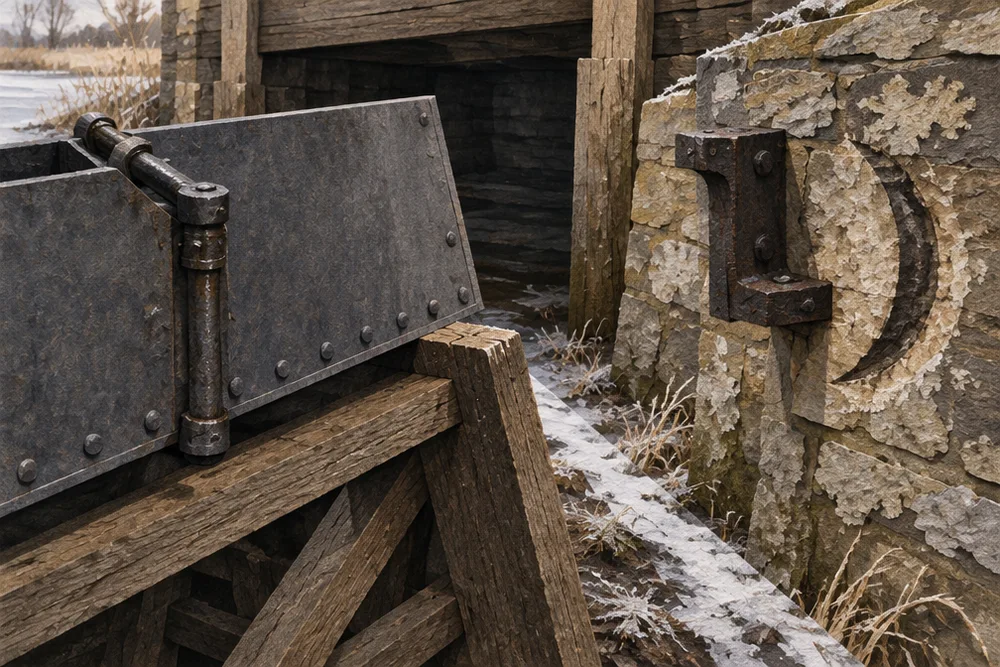
By the time Peregrine Cleeve reached Fenwick Reach, the frost had set a white seam along the ditch and the workmen had already lifted the first stones from the culvert mouth. He found the new flap laid on a trestle beside the path: iron, broad as a cottage door, with a hinge pin thick enough to serve as a boat’s thole. The old bell assembly had been removed. Its empty bracket showed a dark crescent where bronze had rubbed against stone through years of water and silt.
A foreman named Pritchard wiped his hands on a sack. “The iron will sit better than the old contrivance, sir. We can set it before noon, if the frost holds off.”
Peregrine crouched to inspect the hinge. Winter light made the iron look nearly black. Its edges were cleanly punched, its pin greased. The new plate would shut against the masonry when the river pressed from outside and lift when the ditch drained on the ebb. In principle, it was the plainest answer to the problem. In practice, he had learned that a plain answer could conceal a dozen places where water went otherwise.
“The bell?” he asked.
“Gone to the yard with the scrap.”
Peregrine looked at the empty bracket. He had watched the old landing bell sound through the mud as the ebb began, and watched the commissioners’ faces change as Nell Rusk called the water marks down from her cottage. The note had not proved a gate was sound, nor that the culvert could bear a winter’s load. It had proved that the buried passage moved water. The bell had done its work. Still, seeing its place empty made the works feel less like a repair than an erasure.
The culvert arch had been shored with timber while masons worked at the crown. A new stone was to bridge the failed section, set between the old abutments Peregrine had judged sound. He had signed the estimate himself, and the board had accepted it in place of the costly diversion that would have taken two cottage gardens. The responsibility sat in his pocket with his field book, where the corner of the paper had softened against his thumb.
“Noon, then,” he said. “But the flap is not to be fixed until the tenants have seen the lever and understand its movement.”
Pritchard glanced toward the cottages. “They’ll see it when it’s done.”
“They will see it before.”