The Bell That Cost a Ferry Landing
Page 185 of 284
Chapters
The amendment cost little in the field. It would cost more in the drawing room, where Varneck would ask why the line wandered and whether the tenants had been consulted. Peregrine took out his notebook and marked the pots, the washing line, the distance from the ditch to each cottage wall. He wrote: diversion requires acquisition of two gardens; disturbance to household use substantial. Then he underlined substantial once, not twice.
The word did not solve anything. The upper farms had been waterlogged; their owners had refused another levy. Varneck wanted a durable scheme without an open-ended charge. The commission’s temporary plug had shown that water accumulated behind the bank, but not where the old outlet lay. Rosamund Trennick’s landing covered the suspected mouth. A diversion was expensive, yet at least its course could be set out in daylight without dismantling a structure that belonged to a lease bidder.
From the cottage path Peregrine could see the remains of Rosamund’s landing downstream: straight scored planks, a short run of steps, and the dark water beyond. She had built it with her savings and salvaged timber, hoping to secure the ferry lease her mother had once held. The last trial had ended with a flooded washhouse, a withdrawn plug, and a correction Peregrine had signed without naming a channel he could not prove.
He had lost his completion bonus for that correction. It was a small sum against the commission’s work, though not against his own careful accounts. He did not regret the signature. Still, he had to distinguish what he knew from what he suspected, and the distinction had begun to seem less like professional discipline than a narrow ledge over water.
A note had sounded through the mud during the first spring tide. Rosamund had called it the old landing bell. Peregrine had called the bell buried scrap, because he could not see how a bell inside an uncharted culvert could tell them anything reliable. Later, the tenants’ rising water marks had made the possibility of a functioning outlet harder to ignore. The note itself had not proved intent, nor even a clear passage. It had proved only that something had moved.
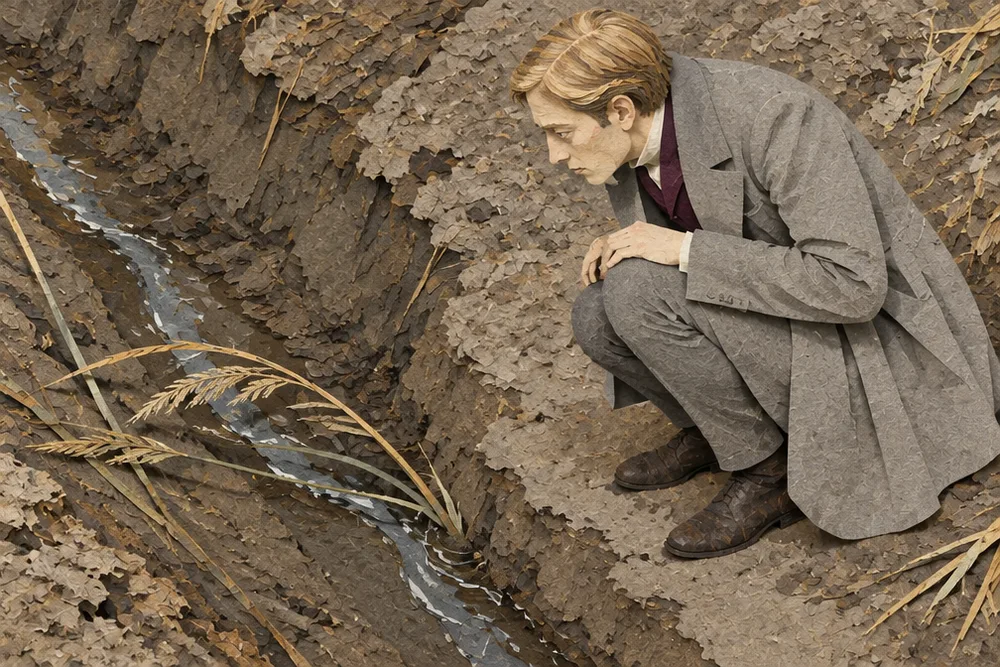
He walked down toward the ditch mouth, where the temporary works had left a shallow trench and a heap of clay. The water there was low, but not still. A thread of it slid past a reed stem, hesitated, then turned back toward the cottages. Peregrine crouched and watched until the movement stopped. Without rain, without a visible stream entering, the ditch was still answering the tide.