The Road Back to Number Nine
Page 92 of 208
Chapters
At the foot of the rise, a removal lorry creaked past, loaded with bedsteads and a rolled carpet. Marta watched it turn toward the newer row, then set off uphill on foot.
The first row of cottages had doors painted in dull greens and blues, all alike except for the numbers nailed beside them. Abel was not in the first house. At the second, a child said no one called Rusk lived there; at the third, an old woman peered through a chain and told Marta to ask at the office. The fourth door opened on a man in shirtsleeves who had heard Abel’s name but not seen him.
The road bent around a shoulder of the hill. Beyond it stood the newest cottages, their brickwork still bright, the plots bare of hedges. Marta counted doors as she went. Her coat had grown warm across her back. The deed shifted against her ribs with every step, an impatient piece of paper that had begun to feel like a summons.
At the last cottage in the row, a woman was shaking a rug over the low wall. Marta asked her. “The old ferryman? He took the one by the track,” the woman said, pointing past a line of freshly dug drains. “There’s a number painted on the door. I saw him go in with a kettle.”
The track was narrow and rough, edged with broken stone. It ran behind the cottages toward the high road, where the valley could be seen below in a sweep of roofs and fields. The reservoir works were a pale scar at the far end, the new embankment rising across the river. From here, Number Nine would have been hidden behind the curve of the old road, below the line of houses.
Marta found Abel’s cottage set apart beside a low retaining wall. The door bore a fresh number in black paint. A wooden box sat on the step, its lid tied down with cord. She knocked. There was a pause, then the scrape of a chair and Abel’s voice telling her to come in.
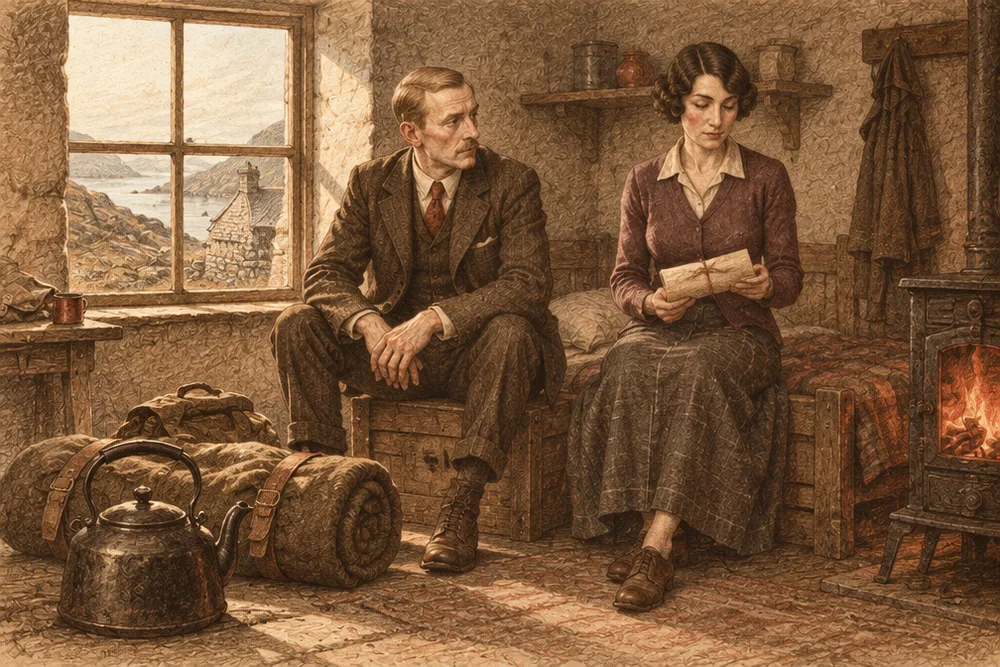
He had not unpacked. A bedroll leaned against the wall; a brass kettle stood on the stove, and his tar-dark reefer hung from a peg. Abel sat at the table with his feet planted wide apart, his white fringe ruffled and his broken nose turned toward her. The brass chain across his chest caught the window light.
“Miss Fennick,” he said. “You’ve come for the other paper.”