The Road Back to Number Nine
Chapter 16 · The Worn Rate Book
Page 179 of 208
Chapters
The hearing room had been arranged to make the board look larger than it was. Three members sat behind a table beneath the Brackenbridge crest; Edwin Pell occupied the middle chair, his pinstripe sleeves aligned with the blotter. Before them, the public benches were full, and more people stood along the wall with their hats held against their coats. Marta Fennick sat at the end of the first row, the old rate book balanced on her knees. Its cracked spine pressed a ridge into her palms.
The hearing had been called to answer one question: why the gates had not closed on the appointed day. Outside, the town’s standpipes gave their thin, measured supply, and the mill’s looms stood idle for lack of water. A man in a flour-dusted collar spoke first. He said his bakery had been promised a dependable flow before winter, and he wanted a date he could put on his order sheet. A woman beside him said her laundry had been reduced to two tubs a day. A third voice from the rear called the delay an insult to every household that had paid its rates.
Pell waited for the murmurs to settle. “The clearance procedure is not a convenience that can be set aside,” he said. “An address has been entered as occupied. Until that entry is resolved, the gate engineer cannot certify the basin clear.” He spoke in the even tone he used across the counter, as though the words themselves had already been copied into a form.
Marta felt the eyes of the room gather on her. Her wages had ended with the clerkship Pell withdrew, and the rent at home still fell due. She could have let the rate book remain shut. Instead, she rose, tucked her narrow shoulders back, and carried it to the table.
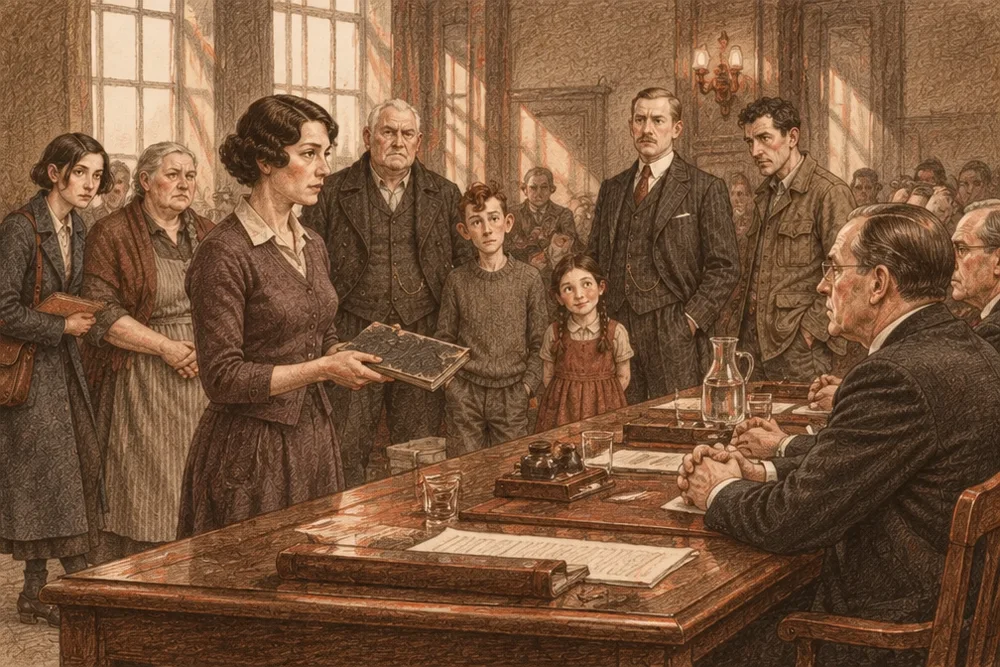
“I found an earlier entry for Number Nine,” she said. “It is listed as a dwelling, not a shed.”
Pell looked down at the book without touching it. “An old rate entry establishes that a dwelling once existed. It does not establish present occupation.”
“No,” Marta said. “It establishes that the address was treated as a dwelling when the board recorded it. The later inspection did not go inside.”
The superintendent’s clipped mustache barely moved. “The exterior was examined. No ordinary access was visible.”