The Road Back to Number Nine
Chapter 3 · Blue-Handed Laundry Notice
Page 23 of 208
Chapters
The notice came folded inside the morning post, its edges softened by the steam from Nell’s kettle. Marta found it beneath a circular from the coal merchant and a bill for soap, addressed in the mill laundry’s square blue hand. She had seen that hand on bundles for seven years: names written on linen tags, figures tallied on the back of invoices, instructions pinned to damp sheets. The paper seemed too clean to belong among their kitchen things.
Nell was at the table, sorting a basket of collars with her swollen knuckles. She had tied her gray braid over one shoulder and braced her hip against the chair, as if the furniture might give way unless she held it steady. Marta put the notice beside her elbow.
“They’ve finished with us,” Nell said, without opening it.
“You don’t know that.”
“I know how they fold a letter when they mean to be polite.” Nell wiped her fingers on her striped apron. “Read it.”
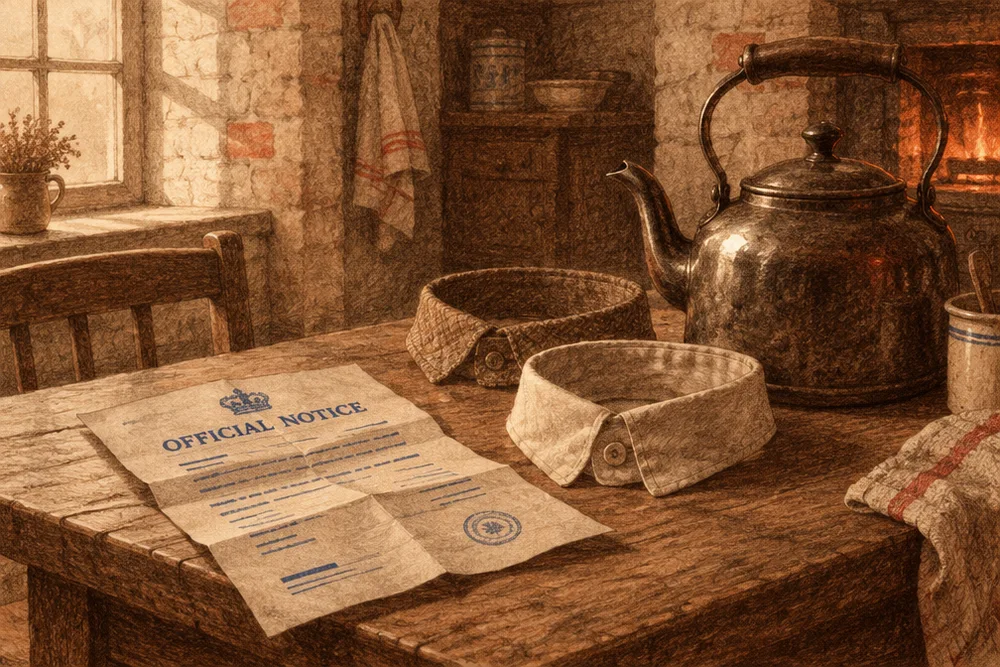
The mill had taken a contract with a larger laundry in Brackenbridge. Their own washing would end at the close of the month; the new concern would collect the linen and return it by cart. The note thanked Mrs. Fennick for her service and promised settlement of the outstanding account. It said nothing about the two dozen sheets already soaking in the copper, nor about the collars in the basket, nor about the iron whose handle Nell had wrapped in cloth against the heat.
Marta read the notice twice. The words did not alter. Outside, a cart rattled over the stones, and someone at the standpipe called for the water to be turned on. The mill’s change of contractor might have sounded small to a person with wages and a room secured by a name on a lease. At their table it was a door closing, one more source of work gone before they had learned what would replace it.
“They can’t have found fault,” Marta said.
“They haven’t found fault. They’ve found a cheaper way.” Nell lifted a collar and examined its whiteness against the window. “That’s harder to argue with.”
For years, the laundry had been the one part of their living that could be counted on. It did not make them comfortable. It made their days legible. Nell knew when the mill’s cloth came in, when the inn’s sheets would be wanted, when a family with a new baby would send out a heap of napkins. Marta knew which bundles had to be returned by noon and how many pennies should be put aside for coal before the rest went to rent.