The Road Back to Number Nine
Page 65 of 208
Chapters
That was the first time he had sounded less like a boy arguing over a convenience and more like someone making a claim. Marta felt the words settle in the small room. She remembered the lodger she had sent away from the board counter in spring, a man whose name had not appeared on the property papers he brought. She had said the rules required an owner’s signature. The man had looked at her as though a rule had been a person who could choose to listen.
Ada picked up her needle again, but did not sew. “A school can’t take a child just because he wants to be known.”
“No,” Marta said. “But it can tell you what it requires.”
Ada turned her face toward Marta. “Is that what you do at the board? Tell people what is required?”
“Often.”
“And do they get what they need?”
Marta had no answer. In the registry, she copied the facts that were put before her. A boundary, a name, a value, a signature. If something was absent, there was a space to leave blank. She knew how a blank could look like nothing rather than a question.
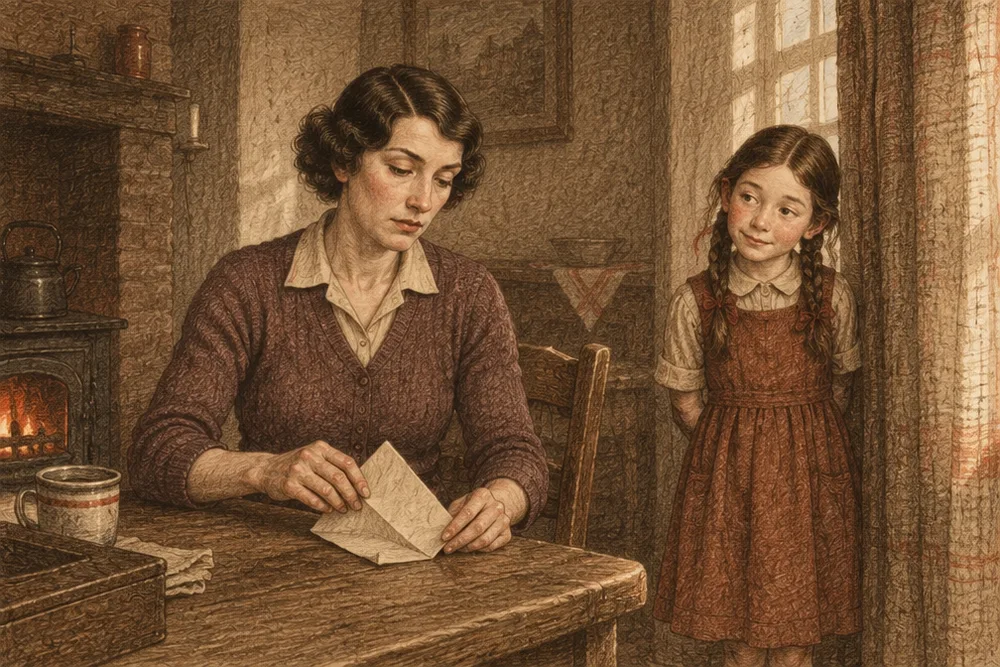
Kit leaned against the doorpost. “If we’re moved, I’ll want to go to the school here.”
“If we’re moved,” Ada repeated, and made the words sound like a door being shut. “You’ll have to let me finish.”
Marta returned her attention to the list. She wrote down the number of curtains, the date promised, and the allowance for the crooked window. Then, on the back of the sheet, she made a small mark beside the words school arrangements. It would not oblige the school board to do anything. It was only a reminder to herself, and even that felt like more than she had been asked to carry.
“Thank you,” she said, folding the paper. “I’ll have the note delivered.”
Ada nodded, her hands busy again. Kit said nothing more. When Marta stepped out into the road, she could hear the measured stitch of the needle behind her, each pull tightening the cloth against the hem.
The cottages stood on a cleared shelf cut into the hillside. From there, the valley fell away in a wide green-brown basin, crossed by the new road and the bright, raw line of construction leading toward the dam. Beyond the roofs, the reservoir works looked larger than they had from town. A crane’s arm rested against the pale sky. Men in caps moved as small dark strokes along the embankment.