The Road Back to Number Nine
Page 49 of 208
Chapters
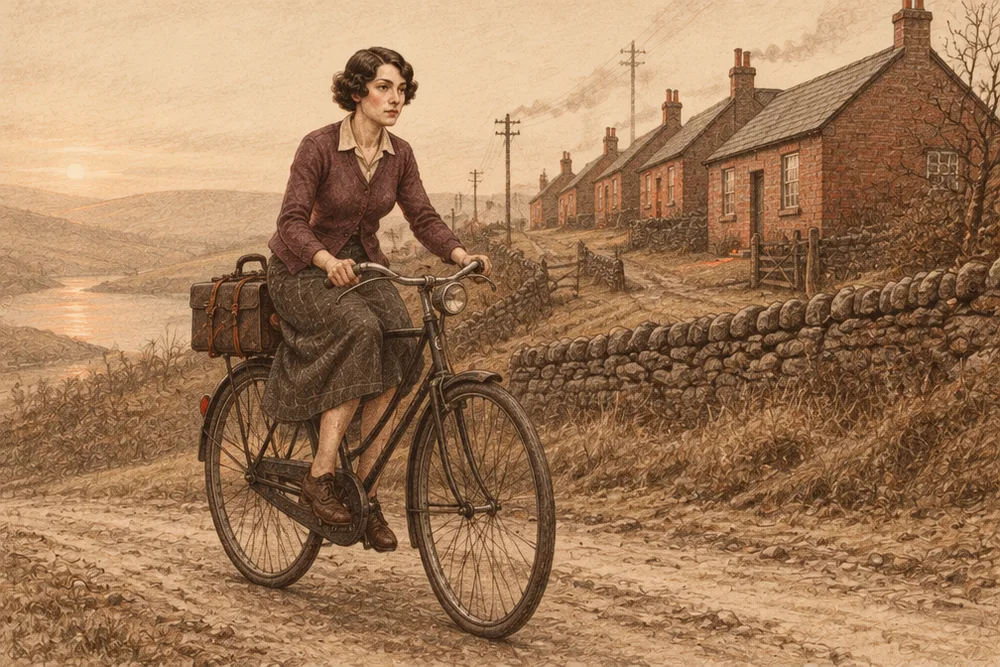
At the gate, she paused and looked back toward the registry windows. The office had taken on its orderly afternoon look: blinds half drawn, desks squared, counter cleared of the morning’s forms. Pell’s room was visible through the glass partition. He was speaking on the telephone, one hand on a stack of documents. Beyond him, the wall schedule showed the reservoir dates in red ink. The closing day was marked in a thick line.
Marta mounted the bicycle. The climb to the resettlement cottages took her past the chapel standpipe. The queue had thinned, but a woman still waited with a pair of pails. She watched Marta pass, then turned her face toward the tap. At the mill, a wagon stood outside the gate, its load covered with canvas. A few men leaned on the wall, talking without much animation.
The road rose past the new houses. Their whitewashed walls reflected the afternoon sun. One cottage had a tidy stack of coal. At another, an open window showed a curtain moving in the air. The people who had moved in were beginning to make the places theirs: a pot on a sill, a broom by a door, a length of washing hung behind a fence. Marta felt a fleeting envy of the ordinary business of it, the work of settling in without wondering whether the walls were secure.
She reached the last bend and stopped to consult her paper. Abel’s cottage was on the far side of the upper lane, among the old ferry holdings. His cottage number was separate from Number Nine, and his payment had been recorded against it. Marta knew he had signed that deed in the registry. She had witnessed him do it: a broad man with bowed shins and a broken nose, his brass watch chain glinting against a tar-dark reefer. He had planted his feet wide and signed with a hand that looked more accustomed to rope than a pen.