The Road Back to Number Nine
Page 41 of 208
Chapters
Marta wondered whether the people in the cart had been offered the cottage with the red scarf on the sill, or one of the others. She wondered whether they had chosen what to take and what to leave, or whether the removal men had decided for them. But the field book required no such answers. It required the number, the classification, and the mark that the visit had been made.
She closed the book and tucked it under her coat. The shed’s padlock was the last thing she saw before they mounted their bicycles. It hung from the hasp as if the door had no reason to be opened.
The lower lane curved around the hillside, and the old toll road joined it near a stone bridge over Marden Beck. Sedge chose the lower way back, saying it would save them the climb to the new road. The bridge had been narrowed by a parapet of rough stone, and a faded milestone stood at its approach. Its face had once shown the distance to Brackenbridge; rain and frost had eaten the figures down to shallow grooves.
They stopped to check a mark by the bridge. A white stake had been driven into a patch of gravel above the water, where the bank was crumbling. The number on it belonged to a small plot on the opposite side of the beck. From the bridge, Marta could see a line of stone foundations along the far bank, half swallowed by nettles.
“Do those have numbers?” she asked.
“They were called the old ferry cottages,” Sedge replied. “Two were down before the scheme began. The third is in the book as uninhabited.”
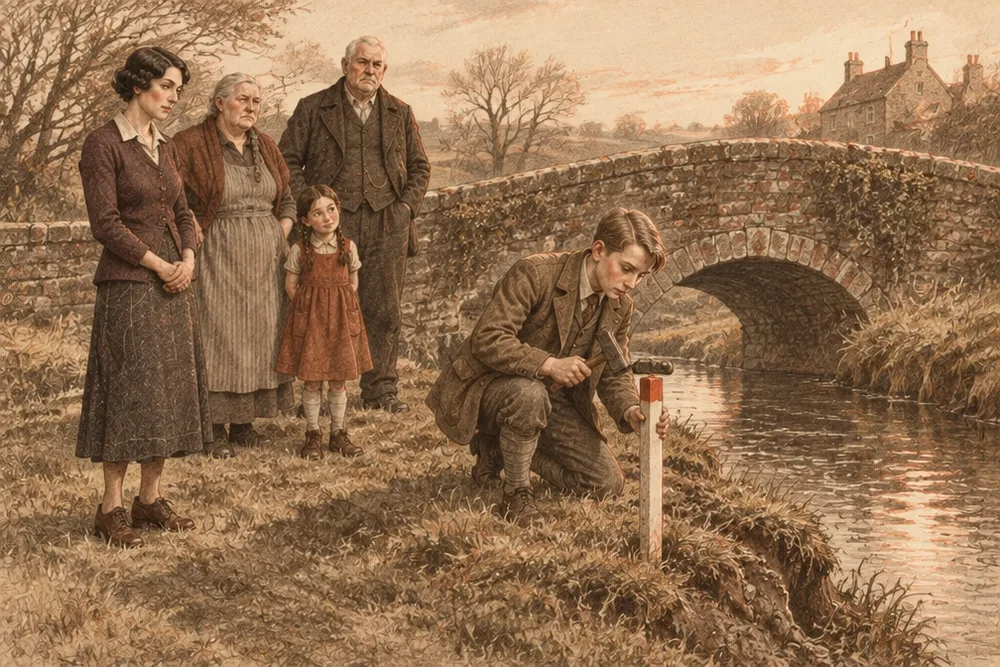
“The ferry cottages,” Marta repeated. She had heard the name in the office. Abel Rusk, who had once taken people across the beck before the bridge was built, had a cottage surrender awaiting a signature. The deed’s papers had come in with the others, tied by string and marked in Pell’s firm hand.
Sedge glanced at her. “You’ll know him from the registry.”
“I have seen his name. He hasn’t signed the separate deed for Number Nine.”
“Then that will be for the clearance clerk to settle.” Sedge crouched beside the stake and looked at the bank. “This mark needs moving. The plot boundary follows the old course of the beck, not the present channel.”
The beck had shifted over the years, cutting the bank and leaving a bend of gravel where the water had once run. Sedge showed her the line of the old channel by pointing to a shallow hollow behind the stones. Marta entered the correction, then copied the new bearing. The pencil lead snapped. She sharpened it with a small knife, turning the blade carefully so the wood fell in pale curls.