The Road Back to Number Nine
Page 38 of 208
Chapters
“One doesn’t. One records what one has done.” He straightened, dusting his hands together. “There’s a temptation to make the register answer more than it can. Don’t give it words it hasn’t earned.”
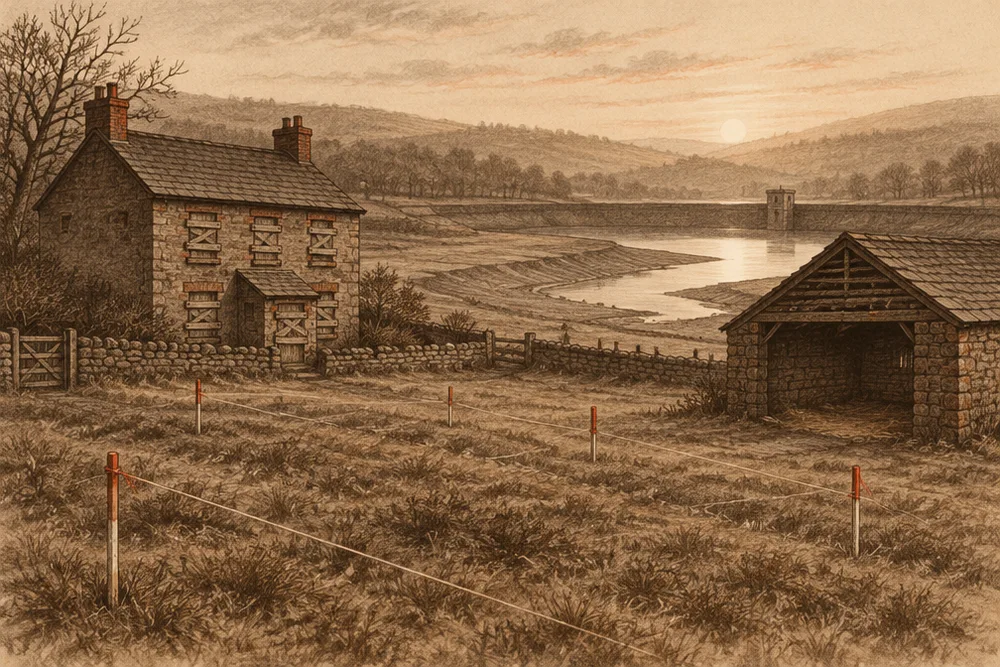
The farmhouse had been listed as a dwelling, and its owner’s compensation papers were complete. That made it a straightforward check. They returned to the road and continued to a cluster of lower outbuildings. The nearest was a stone byre, roof slates missing from one corner. A pair of empty milk cans stood under the eaves. Marta entered it as a store, unoccupied. Sedge looked around the surrounding field and found the painted property number on a fencepost rather than on the building itself.
“The number could be mistaken for the next parcel,” Marta said.
“Then make a note of where it is painted. Whoever comes after us should be able to find the same mark.”
She wrote: “Number on east fencepost, facing track.” There was something reassuring in the precision. A person who came later might not have her memory, but could follow the words. She had often thought the office’s rules were a kind of fence: they kept a clerk from making a careless leap, but also stopped her from reaching what lay on the other side. In the field, a fencepost or a rut or a door left ajar might tell more than the printed line did, if one took the time to look.
Sedge was not a man who hurried past details. He was also not a man who let details become a story before they had earned it. Marta watched him return the map to its oilcloth sleeve. She began to understand why he wanted her with him. She could see a thing; he could tell her what they were permitted to make of seeing it.
The last group of properties lay close to the old toll road. The road had once carried carts between the river crossing and the upper market, but the newer route had left it behind. Its surface narrowed to rutted earth between hedges, and the hedges had grown together overhead in places. A stone post stood at the entrance, its lettering worn smooth except for the word TOLL. Beyond it, the lane dropped toward the beck, then bent out of sight.
Sedge checked his watch. “We’re ahead of time. We can finish the lower marks before we go back.”
Marta glanced toward the road. “Is it included in the clearance survey?”
“The land under the future supply level is included. The road itself will be cut off before the water rises. There’s no point marking every stone.”