The Road Back to Number Nine
Page 140 of 208
Chapters
On the far side the ledge widened enough for her to set both wheels down. Her breath came in sharp pulls. She checked the paper inside her coat; the folded statement had stayed dry. The key was still in her pocket. The deed’s corner had bent, but Abel’s empty signature line remained clear.
The old toll road curved beneath the resettlement cottages and began its descent toward the town. Marta remounted only when the ground levelled. The tyres bumped over packed earth and scattered shale, then rolled more freely. She passed the branching path to Number Nine without looking toward the shed. There was no time to stop, and no question left to ask there. The household had agreed to be named; the board now had to be made to see them.
The old road shortened the return, but it did not make it easy. Its ruts ran between banks thick with nettle and elder, and the rain channels crossed it at angles that jolted the bicycle. Marta kept her weight back on the descents. At one sharp turn, the front wheel slid in loose grit and she swung a leg out to steady herself, scraping her shin against the pedal.
As she dropped toward Brackenbridge, the town sounds grew clearer: a mill whistle, the clank of a cart, a dog barking from behind a yard gate. The reservoir lay hidden beyond the rise. She could not see the dam from this road, but the thought of the gates waiting at their appointed hour travelled with her. Every minute she took to recover the bicycle from a rut was a minute the board could spend marking the valley clear.
At the foot of the lane she found the public road blocked by a handcart piled with timber. The carter had stopped to tighten a rope, leaving just enough room along the kerb. Marta walked the bicycle through sideways, one handlebar scraping a brick wall. She did not slow until the board registry came into view, its windows catching a sharp strip of morning light.
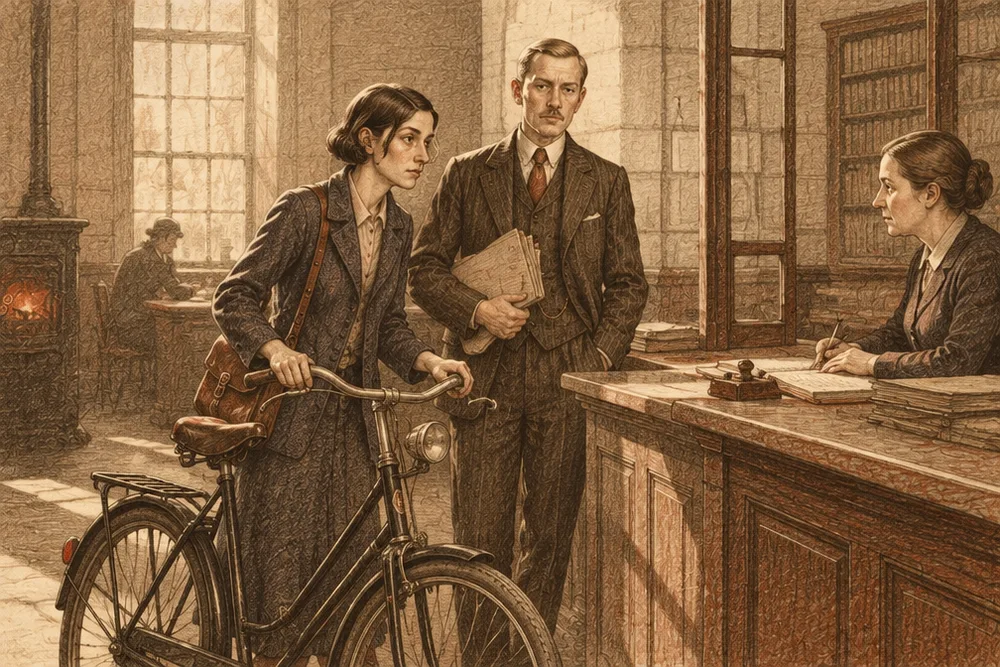
The clock over the entrance showed eleven twenty-seven. She had been gone long enough for the hands to become dangerous. In the front office, the public counter was open. A stack of forms lay beside the brass bell, and through the inner doorway she saw the long register spread across the clerk’s table. Pell stood near it, pinstripe shoulders square, one hand resting on a sheet of paper. His watch chain made a bright curve against his waistcoat.