The Names Beneath the Hem
Page 29 of 249
Chapters
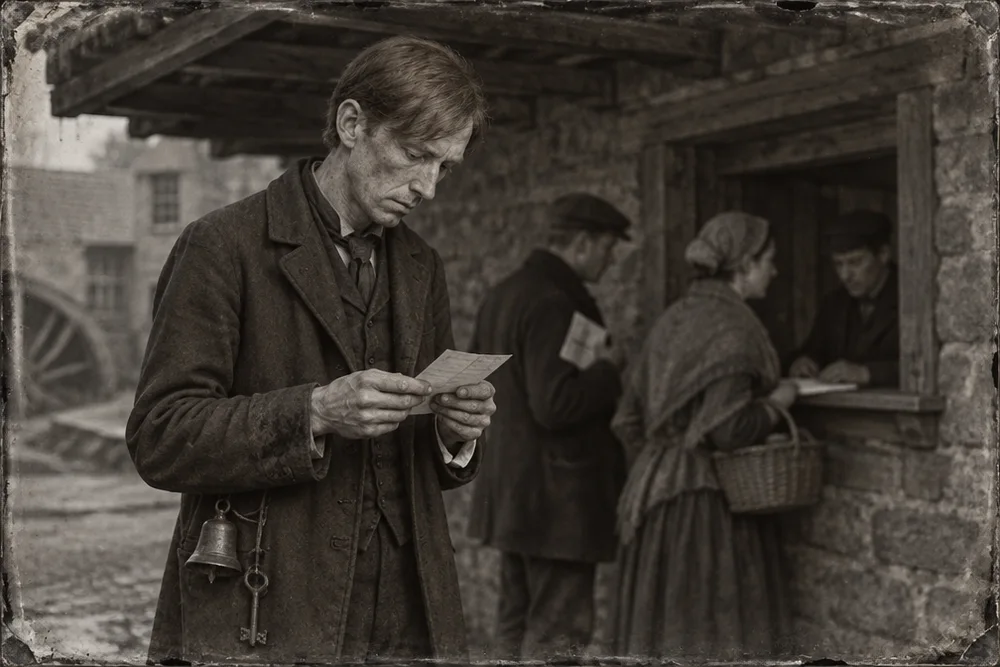
“You may check it while you remain here.”
He worked through the line again. The arithmetic held. The difference was small enough for an owner to dismiss and large enough to make a household’s flour money. The counterfoils showed deductions, not a receipt from the society. They also showed that the total for the second quarter had been marked as sent.
“Where is the remittance voucher?” Jabez asked.
“That is in the accounts.”
“The wages ledger is closed.”
Venn’s mouth tightened. “The counterfoils are all you have leave to copy.”
Jabez blotted the last entry. He understood the limit: Venn would let him establish what the workers had paid, but not what the mill had done with it. It was a door opened only wide enough for a person to see the lock.
The workers at the hatch had changed places when Jabez returned to the lobby. One man held his pay notice flat against his chest. A woman with a mending basket asked the clerk a question too quietly for Jabez to hear. The clerk answered without looking up.
Jabez carried his copies beneath his coat. Venn accompanied him to the door. “You will not represent these papers as a full account.”
“I won’t.”
“And you will not claim the mill owes money on the strength of incomplete figures.”
“I’ll say what they show.”
Venn looked at him for a long moment. “That is a dangerous habit.”
“It was a useful one when I worked for you.”
“You worked for me because I trusted you.”
The words struck with the clean force of a door closing. Jabez moved his right hand behind his back, hiding the ink-dark cuff. “I did what you asked.”
“You did what I paid you to do.” Venn turned away. “Do not confuse that with permission to trouble the sale.”
Outside, Jabez took the long way around the yard so that the women at the hatch would not have to pass him in the narrow door. He read his own copies under the eaves. The total matched his kitchen slate. It still did not prove that the society had received the money, and it did not prove that the mill had kept it. But it narrowed the space in which either account could be true.
He thought of the signature at the bottom of the remittance transfer. He had signed it before he saw any money move. That was a fact he had not put on the slate. It had seemed possible, until Lettice asked what the signature meant, to keep it in the part of the past that did not need an audience.