The Names Beneath the Hem
Page 203 of 249
Chapters
Elias pushed his chair back an inch. “If it needs the wage read, read it. But say whose week it is. I won’t have half the village thinking that was what every man got, nor the other half saying I took it for a full week’s work.”
“Your name and the date,” Hester said. “And the hours were short.”
Lettice started to offer him the pencil so he could put it down himself. Then she saw he was watching the door, not her hand. She turned her sheet so he could see what she had written. He read it without bending and gave one nod.
Below them the inn door opened and the draught lifted the corner of the counterfoil copy. Jabez caught it with his ink-dark cuff. A tread sounded on the stair, quick and light on the lower steps, slower where they turned. Hester moved the slips back from the edge and cleared a place on the dry boards.
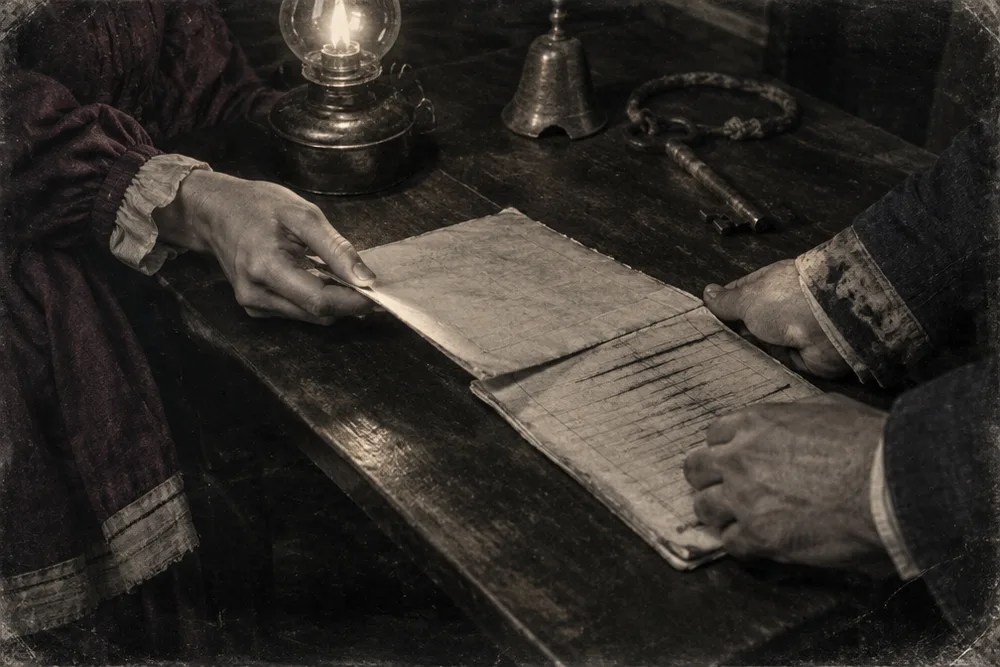
Elias’s wife had kept the pay paper wrapped in a piece of oilcloth in her sewing basket. A girl fetched it from their cottage, running up Tenter Brow and back with the wet hem of her skirt clinging to her legs. Hester took the paper from her carefully, smoothed it on the table, and compared the amount with the society’s deduction schedule. The wage was lower than Jabez’s reconstructed figure by enough to matter.
“I should have asked for the actual packet each week,” Jabez said. “I used the standard rate because the counterfoils did not mark the stoppage.”
“You should have seen the cash leave before you signed it remitted,” Lettice said. The words came sharper than she meant. She did not take them back.
“Yes,” he said. “I should.” He placed his reconciliation beside the pay paper and drew a line through the disputed estimate. “This part is not owed on the evidence we have.”
The revision traveled around the table by voice and by hand. Each person who had expected a larger recovery had to meet the smaller figure in public. A woman who had promised a voluntary advance said she could still give half. Another withdrew her subscription because her son’s cough had worsened. Hester recorded both without reproach. Voluntary money had to remain voluntary, even when its absence threatened the bid.
Lettice saw the deposit shrink below the figure needed for the trustees’ contract. She looked at the list of names that had agreed to lend. No one had been promised a cottage in return. The money they offered would come back only if rents and the purchase terms allowed it; otherwise the risk was theirs. Adding another household claim did not cause the shortfall, but it made the temptation to conceal a short-pay week plain.