The Names Beneath the Hem
Page 137 of 249
Chapters
A man from the top house asked whether a repair reserve could be used to repair a cottage where no rent had been paid. Hester answered that the rules would have to distinguish necessary work from a tenant’s own obligation. Another member wanted to know if the carters would be put in ahead of a family waiting for a room. Lettice repeated the condition: two tenancies only as rooms fell vacant, at rent agreed in writing, and no immediate possession. “That is not the same as a promise that our children may stay,” the man said. “No,” Lettice replied. “It is not.”
The room shifted with the discomfort of a truth that nobody could mend by voting. Their own title would be held by trustees, and future tenants would depend on terms still to be made. Tunstall’s money could prevent a rival from owning the row, but it would not turn a mortgage into common ownership. Lettice watched faces as she spoke, careful not to make the arrangement sound kinder than it was. Her mother’s plum shawl was not in the room; Martha had asked her daughter to bring the terms, not to obtain a decision in her name.
“What is the advantage?” asked an older weaver. “That we may have time to pay, instead of being required to produce the entire balance now. And that Tunstall has agreed not to demand an occupied room for his carters.” “What is the danger?” “The cottages secure the debt, and rent must cover it.” Lettice put her slate on the table. “The lower rooms need repairs. If we do not reserve for them, a low rent today will be a broken roof tomorrow.”
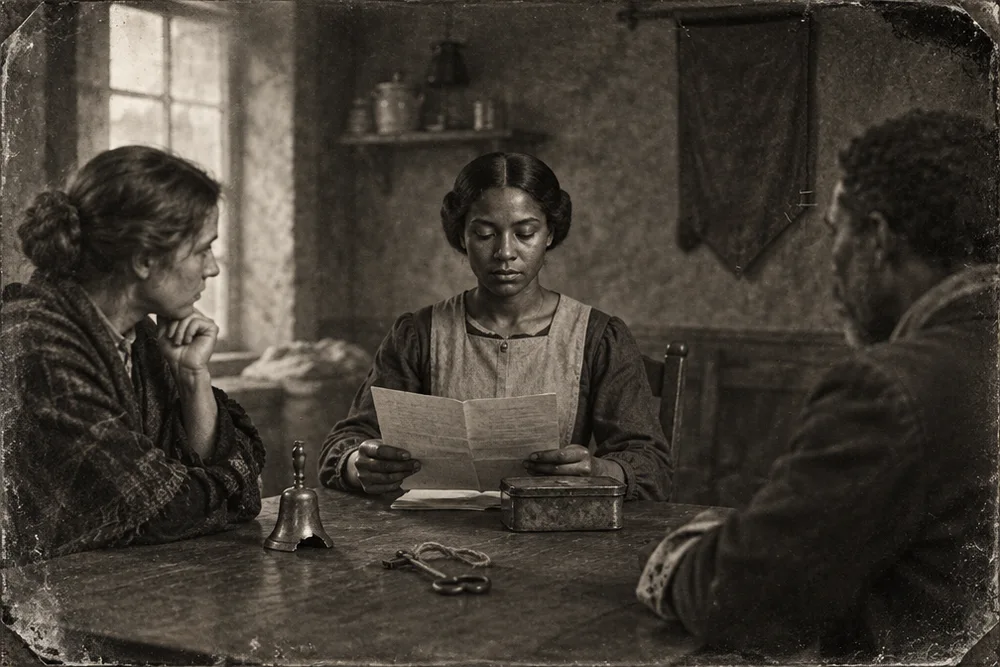
No one asked her to make the choice for them. Hester laid out the proposed deposit, the possible advances, and the sum still missing. The members inspected the columns, and their questions became more precise. One wanted the rate written; another wanted the trustees’ authority limited to repairs voted on or required for safety. A third asked whether Tunstall could change the rent after lending. Hester wrote each question on a separate slip. Nothing was settled by the meeting, but no one left believing the mortgage was a gift.
After the members had gone, Hester folded the question slips into the mortgage paper and put both in her tin rule box. Lettice remained by the table, looking at the figures. “If we take pledges now,” she said, “we may have enough for the deposit.” “And if the terms change?” Hester asked. “We would have to ask again.” “Then we ask again. I will not enter a sum as pledged against a blank condition.”