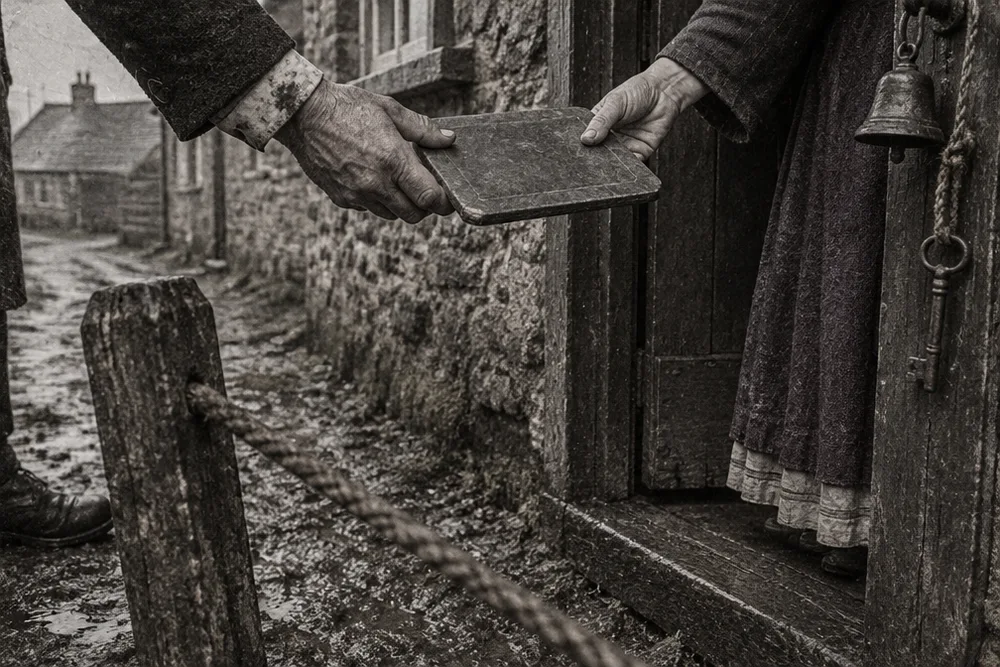
The Names Beneath the Hem
Page 131 of 249
Chapters
They walked the row together, not as partners but because each wanted to know what the other had counted. At the second house a woman had stuffed cloth beneath the window sash. At the fourth, a cracked hearth stone had been propped with a brick. Tunstall measured the lane width and spoke of cart wheels; Lettice noted which doors had a sound step and which tenants had already bought their own coal. When he reached the washhouse lane he stopped. The building stood beyond the boundary peg, its small windows clouded, its roofline lower than the cottages’ roofs.
“That is not included?” he asked. “The mill sale separates it from the row.” “Then a buyer of the houses cannot promise a washhouse.” “No.” Lettice watched his face as he recalculated. Laundry was not an ornament to a cottage, any more than a dry hearth was. The mill had made the division on paper; the village would have to live with it. Tunstall rubbed his thumb along the edge of the yardstick. “My carters would need somewhere to wash themselves, if I put them here.” “And the women need somewhere to wash for pay,” Lettice said. “If you take the row, you cannot make the lane your yard.”
He looked toward the lower door again, where a pale seam of water showed beneath the threshold. “I cannot pay what I first thought and still make repairs.” “Then do not.” Lettice’s answer came out sharper than she intended. “But do not count a wet room as a reason to take the whole row cheap and clear it of the people who know how to keep the rest standing.” Tunstall’s mouth flattened. “I have made no such threat.” “Not yet.”
He did not take offense, or let her have the satisfaction of seeing it. Instead he folded the card bearing his lowered bid and slid it into his coat. “You are asking me to believe the repairs will be done.” “I am asking you to look at the repairs, not pretend they can be wished away.” At the bottom house he had marked a sum for boards and lime. Lettice had recorded the same need on her slate, with the tenant’s name beside it. She showed him. He read the name, then glanced at the door, as if it mattered who would still be there to open it. He gave the slate back without comment.