The Morning We Closed Up
Chapter 12 · The Free Half Hour
Page 114 of 236
Chapters
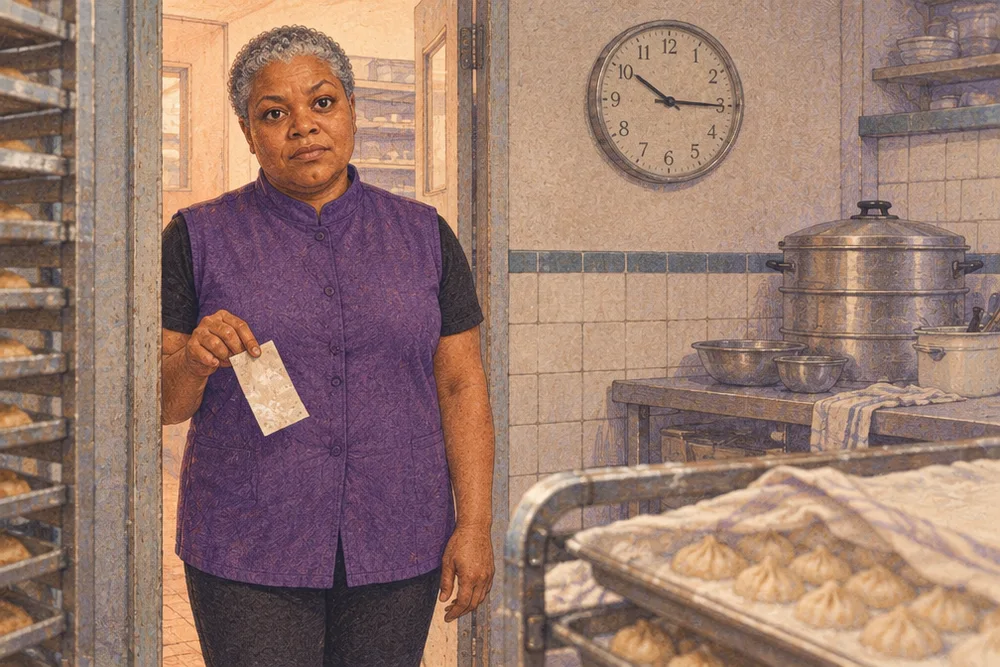
The first time Nell Tassern asked for her half hour back, Rafael thought she was joking. She stood in the doorway with a flour-smeared delivery docket pinched between two fingers, violet vest buttoned to the throat, and the expression she used when someone had put a wet tray on a dry shelf. Behind her, the kitchen clock ticked past ten. Her booked shift had ended at nine-thirty.
“I have a van at the south entrance,” she said. “It leaves in twelve minutes.”
Rafael looked at the racks. Nell’s dumplings sat in neat rows beneath damp cloths, waiting for the steamer. Ivo’s cart stock—two crates of bread rolls and a tub of marinated onions—occupied the prep table beside them. The kitchen smelled of yeast, ginger, and the sharp clean sting of sanitizer. His own clipboard showed Nell’s booking ending at nine-thirty. The margin below it held a penciled note: HALF HOUR FREE—R.C.
He had written it himself, three weeks earlier, after her first batch ran over. The steamer had been slow to recover temperature. Nell had looked at the clock, then at the crates she had to pack, and Rafael had said not to worry about the extra time. It had seemed less like a favor than a sensible way to keep a good renter from losing money over a temperamental machine.
“I’ll get you out,” he said.
Nell’s chin tipped forward. “You said that at nine-thirty.”
He stopped. The answer he wanted to give—that the van could wait, that he could carry the crates, that he would make it right—was already assembled. So was the next hour in which he would do Nell’s cleanup himself and call it nothing. He looked down at the docket instead. The driver’s number was written in block letters. The departure time was circled twice.
“You’re right,” he said. “I should have stopped the work when your booking ended.”
“Should have.” She set the docket on the counter. “Now I need a plan, not an apology.”
Rafael set the timer for the steamer and checked the water gauge. It had climbed to temperature, finally. He could load the baskets, shut the lid, and have the first batch ready in six minutes. Nell could pack while it cooked. If he moved the second rack himself, they might manage the van. He had done this calculation before she finished speaking, the way he used to judge a loaf by its sound against the oven stone.